

A new player joins a league and opens the leaderboard. The leading score reflects months of participation. The newcomer has barely found the venue.
The ranking may be accurate. Its usefulness depends on what it helps that person understand and pursue.
A well-considered leaderboard should recognize established players while offering newcomers meaningful ways to participate. Seasonal views, relevant comparison groups and visible personal progress can help, provided the rules stay clear.
Joris Beerda’s July 2026 discussion for The Octalysis Group explores several approaches to this problem.1 I would use those ideas as design options to test with a league, rather than assume one display will motivate everyone.
The workflow below is for a hypothetical league.
Decide what the comparison is meant to recognize
Start with the meaning of the score and the competition period. Performance, participation and consistency are different measures. The interface should not blur them into a single mysterious quantity.
Keep the official standing clear
If the league has an official competitive table, players should be able to find it and understand how it works. Recognizing the leaders is part of respecting the competition.
Show the relevant season or event, scoring basis and any important eligibility conditions. If a secondary view uses a different measure, label that difference prominently.
The answer to a daunting ranking is not to invent a more flattering version of the same result. People deserve an honest picture and another useful thing to work toward.
A regular who has earned a strong position should not need to submit a missing-person report for their achievement.
Choose a period that supports the activity
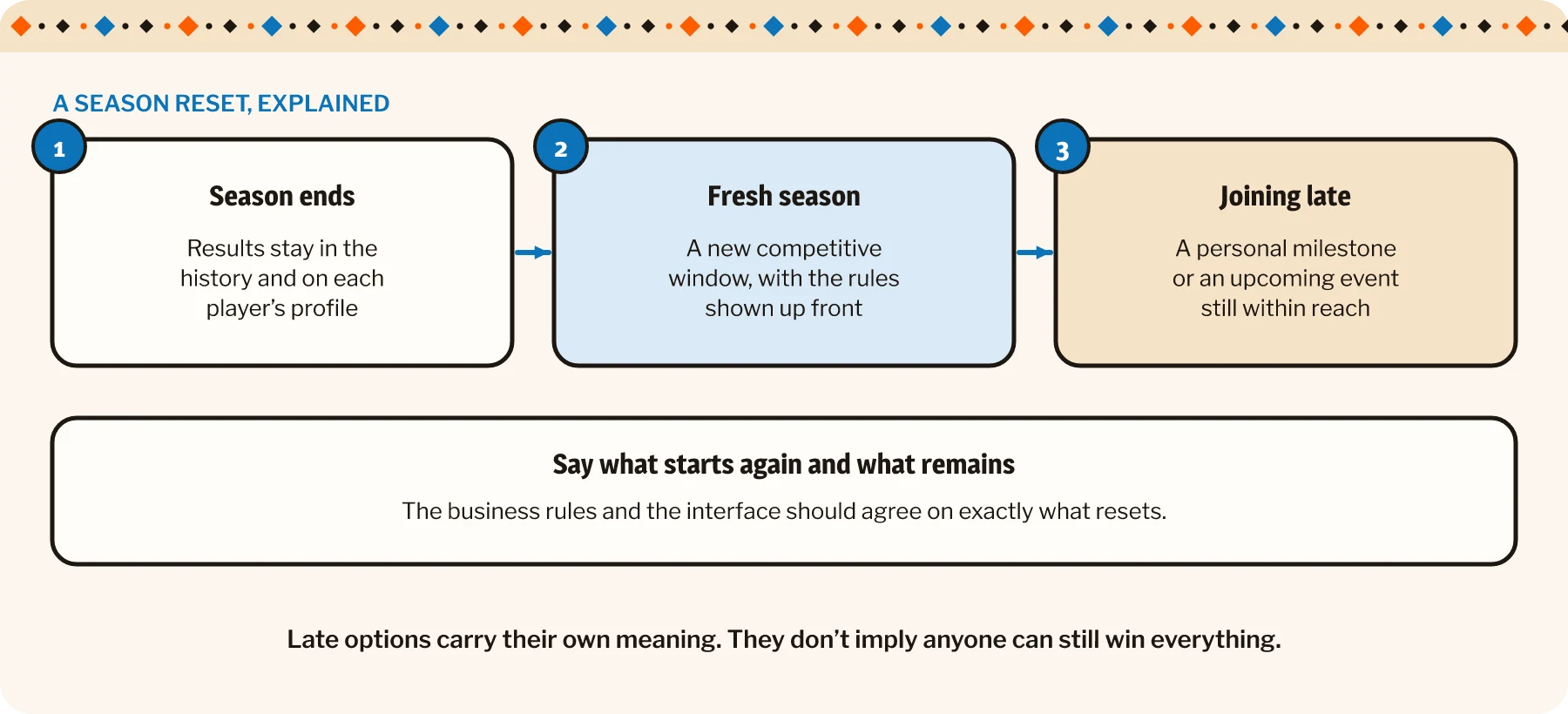
A defined season can create a fresh competitive window while preserving earlier results in the historical record.
The reset needs a clear explanation. What starts again, what remains on the profile and which outcomes belong to the completed season? The business rules and the interface should agree.
Rock ’n Roll Poker League is one of our favourite gamified builds. See how the Octalysis framework shaped its custom .NET platform.
Fresh season, clear rules, another opportunity to take part. Ayeya!
For someone joining late, consider what is still realistically available during the remaining period. A personal milestone or a suitable upcoming event may be more relevant than chasing an overall position that is effectively out of reach.
Those options should have their own meaning, rather than imply that every player can still win every competition.
Add a useful personal perspective
The overview can connect an accurate standing to a next step that feels understandable for the individual.
Compare within a relevant group
A venue, a defined experience group or another meaningful cohort may create a more recognizable comparison.
Explain who belongs in the group and why. A small table is easier to interpret when the player knows what qualifies someone to appear there. If membership changes, make that behavior understandable.
Avoid assuming that all newcomers want a special label or that all regulars want the same challenge. A choice of clearly named views may work better than an imposed category.
For a league spanning venues, also check whether the comparison reflects differences in opportunities to participate. A group can look fair in the interface while its scoring favors a schedule that only some players can attend.
Pairs well with A new player needs a reason to look at the leaderboard again.
Show movement and the next meaningful target
A player’s recent progress can provide useful context alongside their current rank. The relevant detail might be a personal best, a change within the season or progress toward a defined participation milestone.
A nearby-rank view may help some people see the next competitive step. It should remain connected to the full context and avoid promising a result based on points alone if other eligibility rules apply.
Keep personal progress distinct from official qualification. Someone can make a worthwhile improvement without meeting every condition for a final event. The display should explain both facts comfortably.
| What it shows | Keep clear | |
|---|---|---|
| Official standing | The competitive table for the season or event | The scoring basis and any eligibility conditions |
| Relevant group | A venue, an experience group or another meaningful cohort | Who belongs, why, and how membership changes |
| Personal progress | A personal best, movement this season or progress to a milestone | That progress is not the same as qualification |
Before choosing the final presentation, review it with a newcomer, a regular and someone returning after an absence. Ask each person what the numbers mean, which rules apply and what they would do next.
Observe whether the page helps them find an achievable purpose. Also check whether the leader still receives appropriate recognition and whether staff can explain the different views.
There is no universal leaderboard arrangement that removes every difference in experience or participation. A useful design makes those differences understandable and gives people a fair route into the activity.
The regulars can keep setting a high standard. The newcomers should still feel that turning up is the beginning of something, rather than a very elaborate way to read someone else’s victory speech.