

Give people a points system and they will explore it.
That is part of the fun. It is also a good reason to decide whether pressing the same button twice should count as exceptional commitment.
The XP work around Rock ‘n Roll Poker League brings an operational side to gamification: an award needs a reason, a rule and a record that the league can explain. This part of the series concerns those engineering requirements, rather than announcing that every safeguard discussed here is already implemented.
RnR distinguishes Poker Points tied to table performance from XP associated with wider participation and engagement. Keeping those meanings clear is the starting point. The system then needs to apply the relevant season’s rules consistently.
The following examples describe possible rule designs. They are not the league’s current published XP schedule.
Name the kind of rule before the number
An illustrative participation award might apply once for an eligible game. A profile milestone might apply once to the player. A seasonal challenge might have a defined window and a cap.
| Applies | Needs a decision on | |
|---|---|---|
| Participation award | Once for an eligible game | What counts as the same participation |
| Profile milestone | Once per player | What happens if it is corrected later |
| Seasonal challenge | Within a defined window, up to a cap | Which time zone sets the window, and late results |
Those are different kinds of rules. Treating them all as “add some points” leaves important decisions to chance.
Give every award a traceable reason
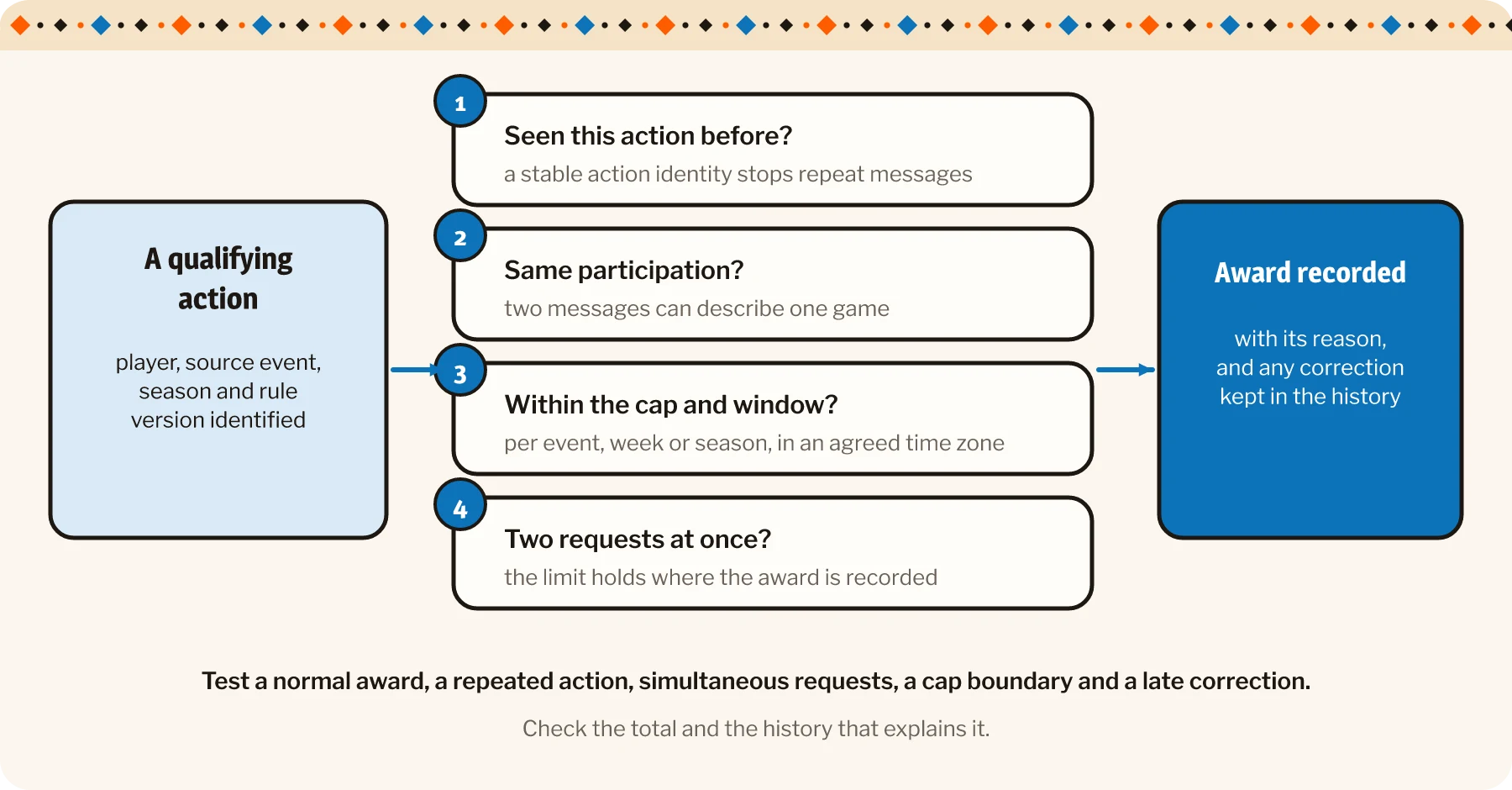
For an award, keep the relevant player, qualifying action, source event, season and rule version identifiable. That gives the system a way to establish what happened and gives staff something useful to inspect.
Repeated technical messages should not create repeated awards. A stable action identity helps detect duplicate processing.
Want to see this in a real league? Read how we built Rock ’n Roll Poker League’s gamified platform.
The business rule may need an additional boundary. Two different messages could still describe the same eligible participation. The application needs to recognize that relationship, rather than assuming that a new message identifier always represents a new achievement.
Concurrency deserves attention too. Two requests can arrive before either sees the other’s work. The final constraint needs to hold where the award is recorded, with suitable coordination around the business rule.
Otherwise, the points total may develop the generous spirit of a game-show host.
Define the limits and the clock
Caps and windows need equally clear definitions. Is the limit per event, per week or per season? Which time zone defines the boundary? What happens when a result is recorded late?
The answer should come from the league’s operating policy. Code can enforce a decision very consistently while still enforcing the wrong decision.
Make corrections visible
Corrections also need a visible route. If an award is reversed or adjusted, preserve enough history to explain the original entry and the correction. A silent total change makes it harder for both the player and the support team to understand the result.
Catch up on the series: RnR, part 2: Give players a reason to return, then choose the mechanic.
Administrative tools should show the relevant evidence and require appropriate permissions for adjustments. Staff need a reason field and a clear way to inspect the effect, without receiving unrestricted access merely to resolve one question.
The player-facing view can present a simpler explanation: what was recognized, when and under which relevant conditions. Detailed technical records belong behind that explanation, available to authorized staff.
Test the awkward cases before release
Before releasing a rule, I would test a normal award, a repeated action, simultaneous requests, a cap boundary and a late correction. Check both the total and the history that explains it.
The motivational design and the accounting need to agree. A reward that people value will attract attention, including questions when something seems missing.
That is a healthy sign of interest. The system should be ready to answer with something better than a shrug and a number. The creative part can remain in how players enjoy the league; the arithmetic should be reassuringly dependable.