

A franchise inquiry can begin with a simple ambition: someone wants a business that fits the way they hope to work and live.
The software should help a consultant understand that ambition. It should not immediately translate it into whichever brand has the most convenient slot in the database.
The IFA’s February 2026 outlook anticipates continued growth in franchising.1 That provides useful sector context, but a growing market does not establish that a particular opportunity suits a particular person.
For a proposed franchise-matching workflow, I would focus on transparent criteria, current availability and a consultant-led conversation. Here is how that could work in a hypothetical system, rather than a description of features delivered for a client.
Collect information that changes the shortlist
The first stage should gather enough useful context to support the next conversation. Explain why each important question is being asked.
Separate requirements from preferences
Someone may require a particular territory while remaining flexible about the industry. Another person may care most about their day-to-day role and have several acceptable locations.
A useful initial profile might cover:
- Preferred location and any nonnegotiable geographic limits.
- The person’s intended operating role and involvement.
- A relevant investment range for the discussion.
- Industries or working environments they want to explore.
- Timing and questions that need a consultant’s help.
Let people indicate uncertainty. “I need help understanding the options” can be a more accurate answer than a required choice made simply to get through the form.
Keep the early questions proportionate. Detailed supporting information can be gathered at the appropriate stage through the agreed process. A first conversation should feel like finding a direction, rather than applying to become the direction.
Show the basis of each suggested match
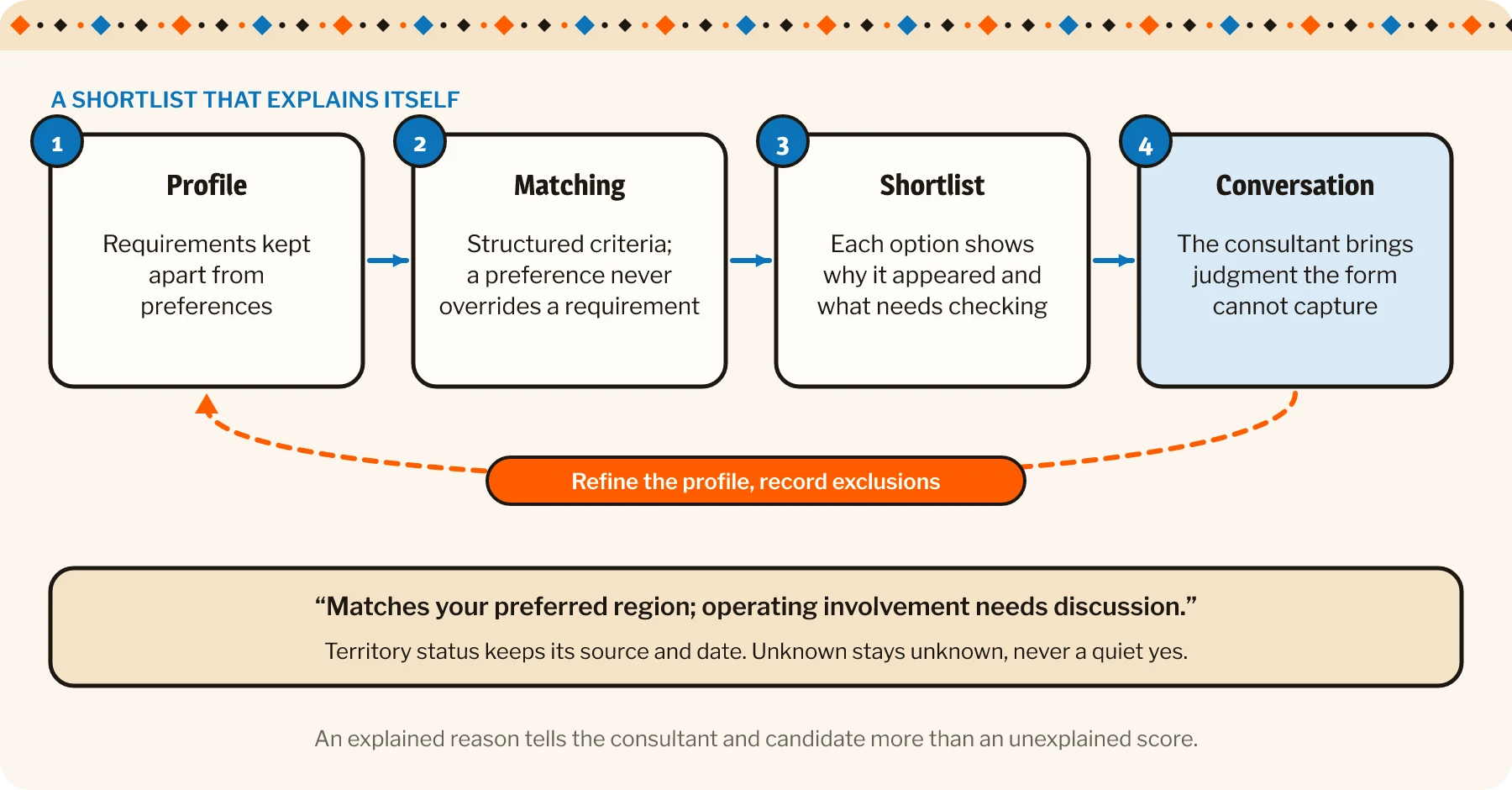
The system can use structured criteria to prepare a shortlist. The result should help a person understand the fit and the unresolved questions.
Explain the useful overlap
For each option, show the relevant reasons it appeared: geographic interest, broad operating model or another verified criterion.
A short explanation can be more informative than an unexplained score. “Matches your preferred region; operating involvement needs discussion” tells the consultant and candidate what to explore.
We build for franchise consultants too. See the site we made for Your Future Franchise.
A score can still have a place if its meaning is defined. Avoid presenting a percentage as though it were the probability of business success. The calculation may only reflect how several fields align.
The system should also preserve the candidate’s priorities. A weighted preference should not quietly override a stated requirement.
Keep availability and missing information visible
Territory information can change. Record its source and date, and distinguish a preliminary indication from availability confirmed through the appropriate process.
Unknown should remain unknown. If an option’s territory status has not been checked, flag it for review instead of treating a blank field as a favorable answer.
The same principle applies to brand information and operating requirements. A matching engine is only as useful as the data and definitions behind it.
Where commercial relationships affect which opportunities are included or prioritized, the presentation should make the relevant scope understandable. People can assess a shortlist more fairly when they know what it represents.
Use the shortlist to improve the conversation
The consultant brings judgment that a set of form answers cannot fully capture. The system should support that work with a readable profile, matching reasons and unresolved issues.
Related read: A franchise quiz should give people something useful to think about.
Let the person refine the direction
A candidate may see the initial options and realize that their preferred working role was described incorrectly. Make that easy to discuss and update.
Record material changes so the next shortlist has an understandable basis. If the consultant excludes an option after a conversation, capture the reason for the team rather than letting it reappear in every automated refresh.
A useful handover might identify two promising directions and several questions to verify. It does not need to pretend that a life-changing business decision has been settled by a cheerful progress ring.
Before using the workflow widely, test a few representative profiles with the people who will handle the consultations. Include conflicting preferences, incomplete availability and candidates who change their minds.
Check whether the shortlist creates a better conversation and whether staff can explain its recommendations. Completion counts alone will not reveal whether the options are relevant.
The best outcome is a person who understands why an opportunity is being discussed and what remains to investigate. The consultant starts with useful context, and the software does the organizing.
That leaves room for a proper human conversation, which is generally a sensible feature when somebody is considering a different future.