

nopCommerce 5.00 was released on October 27, 2026.1 Its official announcement highlights a move to .NET 10 alongside capabilities including native price lists and cXML PunchOut support.
For a business using nopCommerce, that is worth reviewing.2 The useful next step is to connect the release to the store’s requirements, customizations and maintenance plan.
A major version is an invitation to assess the product. It is also a remarkably efficient way to make everyone remember the shipping plugin they have not thought about since installation.
The decision looks different for a new build, an existing customized store and an upgrade already being planned.
| Start with | The evidence you need | |
|---|---|---|
| A new build | The real commerce workflow, such as contract pricing or procurement | A prototype against the official documentation and your exceptions |
| An existing customized store | Each extension, custom code and integration | Stated 5.00 support and a rehearsed migration on representative data |
| An upgrade already in planning | A fresh comparison of the routes | Recorded reasons for the target, chosen before the scope is settled |
For a new build, assess the release against the complete job
A fresh project gives the team an opportunity to evaluate the current platform before custom work accumulates.
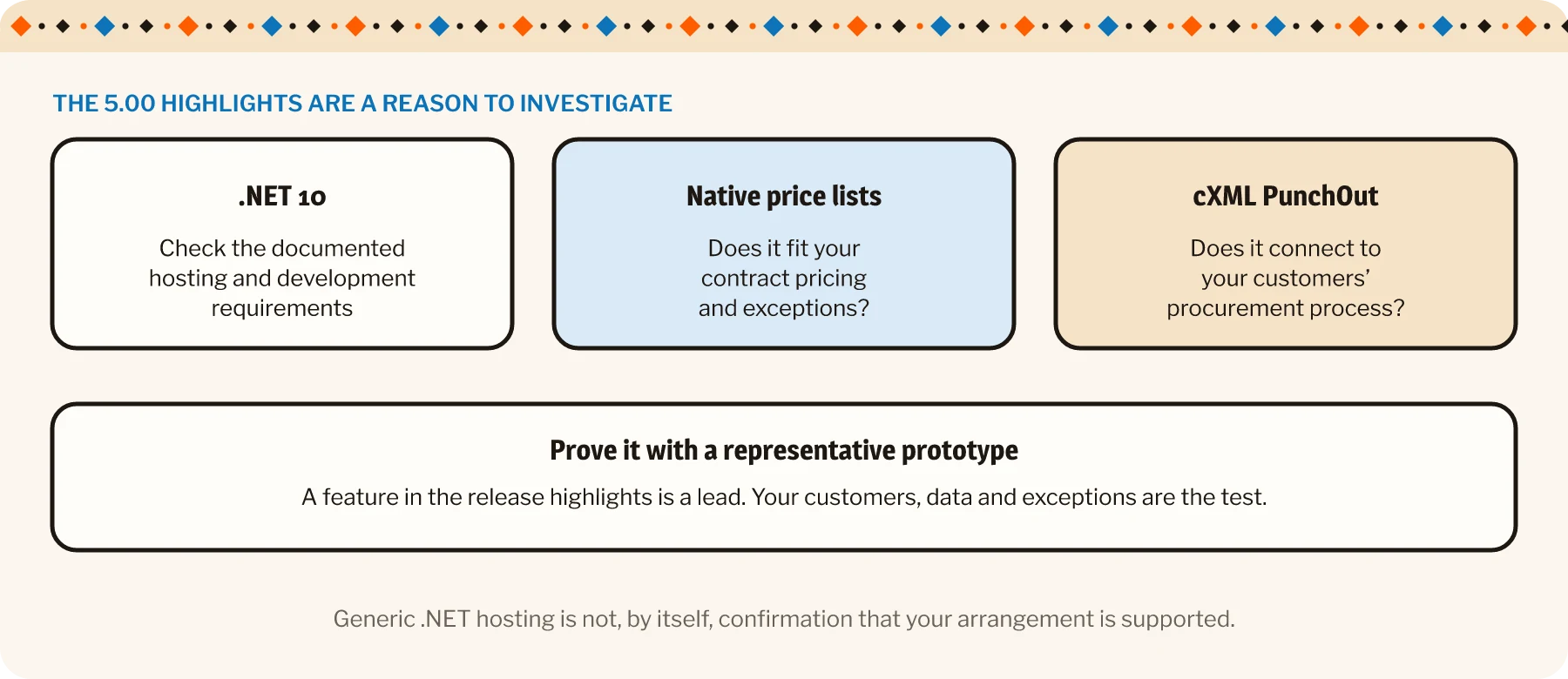
Start with the real commerce workflow. If the business needs contract pricing or a connection to a corporate procurement process, the relevant 5.00 capabilities may affect the architecture and scope.
Confirm the details through the official documentation and a representative prototype. A feature appearing in the release highlights establishes a reason to investigate it. The business still needs to know whether it handles its customers, data and exceptions appropriately.
The .NET 10 move also affects the technical environment. Check the documented hosting and development requirements for the chosen deployment. A provider offering generic .NET hosting is not, by itself, confirmation that the specific application arrangement is ready.
For an existing store, establish the compatibility path
The platform is one part of an operating store. Its plugins, theme, custom code and integrations need a route to the target version.
As nopCommerce Silver Partners, we’ve put this into practice. See the nopCommerce store we built for Freddy’s Jewelry.
Obtain evidence for the versions you intend to use
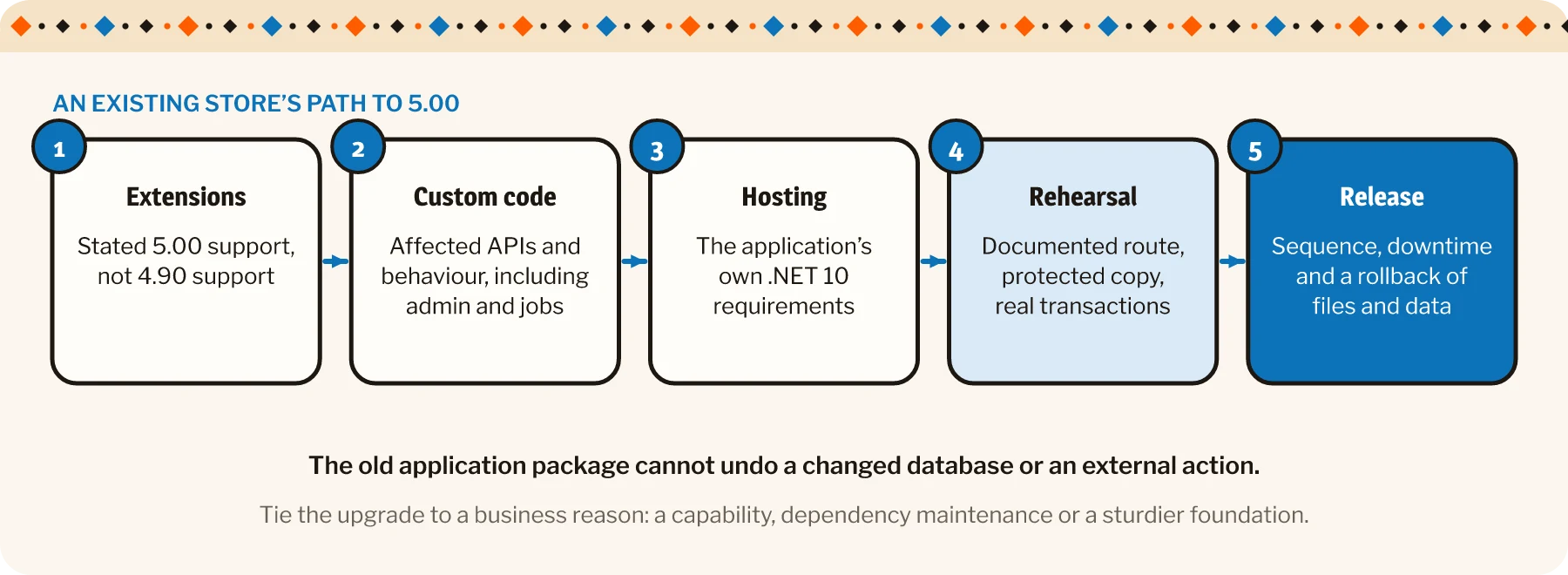
Check each essential extension’s stated 5.00 support and the relevant vendor guidance. Compatibility with a 4.90 maintenance release does not establish compatibility with a new major version.
For custom extensions, review the affected APIs and behavior, then test the important workflows. Include administration tasks and background work, not only the storefront.
Runtime support is useful context, but it does not settle the maintenance position of the whole store. The application, extensions and hosting arrangement have their own requirements.
I would also connect the upgrade to a concrete business reason: a required capability, dependency maintenance or a more sustainable application foundation. That makes prioritization easier to discuss than a general feeling that the version number has become slightly embarrassing.
Rehearse the change with representative data
Establish the documented migration route for the exact starting version. Include custom data structures and any external records that must remain consistent.
Run the process in a protected environment, check the data and exercise complete transactions. Confirm the deployment sequence, expected interruption and recovery options.
A rollback needs compatible application files and data. The old application package cannot automatically undo a changed database or an external action.
The aim is a release decision supported by evidence about this store, rather than a general declaration that the platform is ready.
Worth reading next: nopCommerce 4.90: where the new quoting workflow could help B2B stores.
For an upgrade already in planning, compare the targets again
A newly available major release can justify reviewing an existing plan. It does not automatically mean that every project should change destination.
Compare the practical routes. Which required extensions are available? What custom work differs? Does a new platform feature replace something the team was about to build? What support and maintenance position does each route provide?
There may be a sensible reason to target 5.00. There may also be dependencies requiring a staged approach or further investigation. Record those reasons and keep the target explicit.
Zulu Shack recommends making that decision before the implementation scope is treated as settled. A short reassessment is easier than discovering halfway through that the team is discussing two different upgrades.
The verified release is welcome news. The official changelog and each extension vendor’s compatibility guidance belong in the detailed technical review.
A good upgrade brings the business’s useful behavior forward with a maintainable path behind it. The version number can mark the occasion. The store still needs to take orders on Monday.