

People are using the AI feature. That is encouraging.
The next question is what happens after they use it.
A busy assistant can be helpful, entertaining or repeatedly asked to repair its previous answer. Usage counts do not distinguish those possibilities. To assess business value, connect the feature to a completed task and include the work that remains for people afterward.
Here is a hypothetical review of an internal assistant that helps staff prepare product information for customer inquiries. Every number below is illustrative, not a result from a Zulu Shack project.
Follow the task beyond the generated response
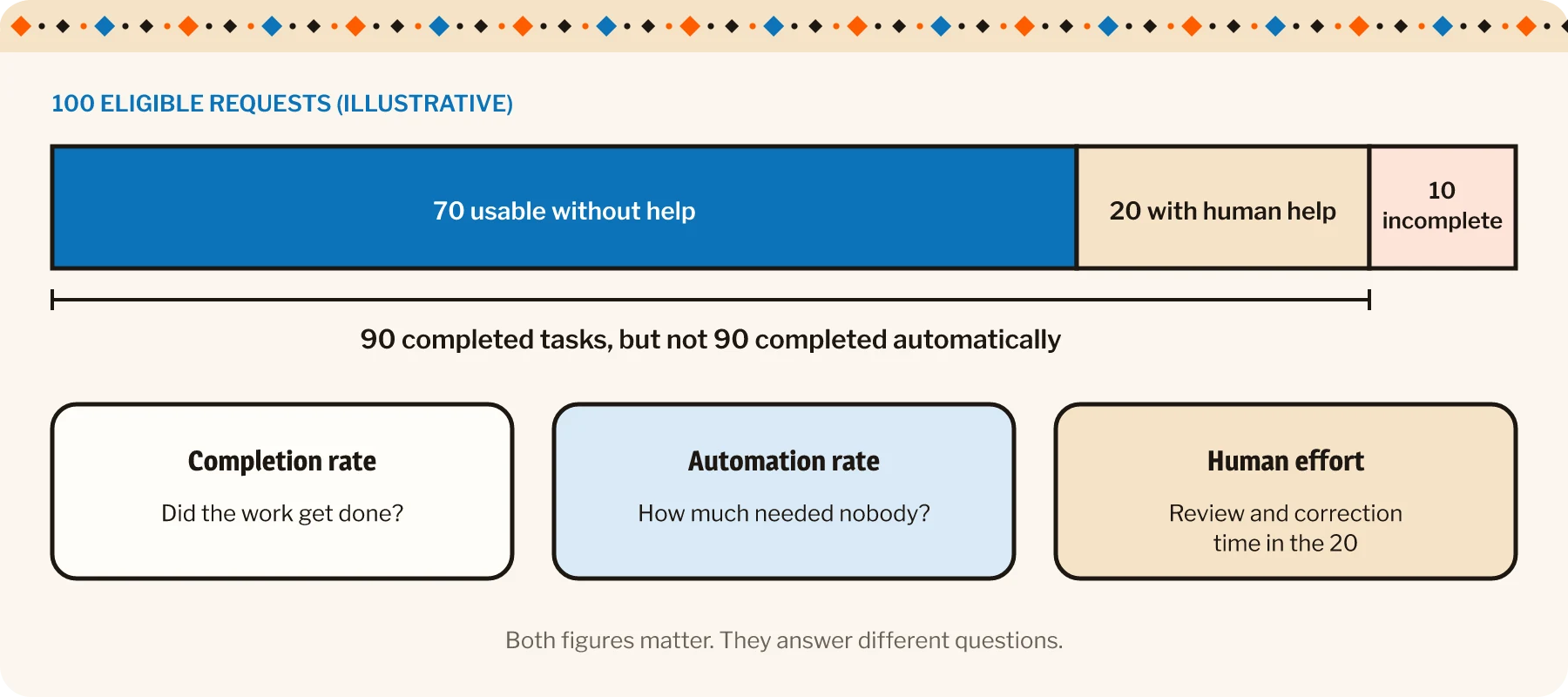
Suppose the assistant handles 100 eligible requests during the sample period. Seventy reach a usable completed result without further help. Twenty are completed with human intervention, and ten remain incomplete.
That is 90 completed tasks, but it is not 90 completed automatically. Both figures matter, and they answer different questions.
The team also needs a consistent definition of completion. For this example, a fluent draft is insufficient if the product information is wrong or the requested details are missing. The result must satisfy the agreed inquiry requirements.
Inspect the work inside the exceptions
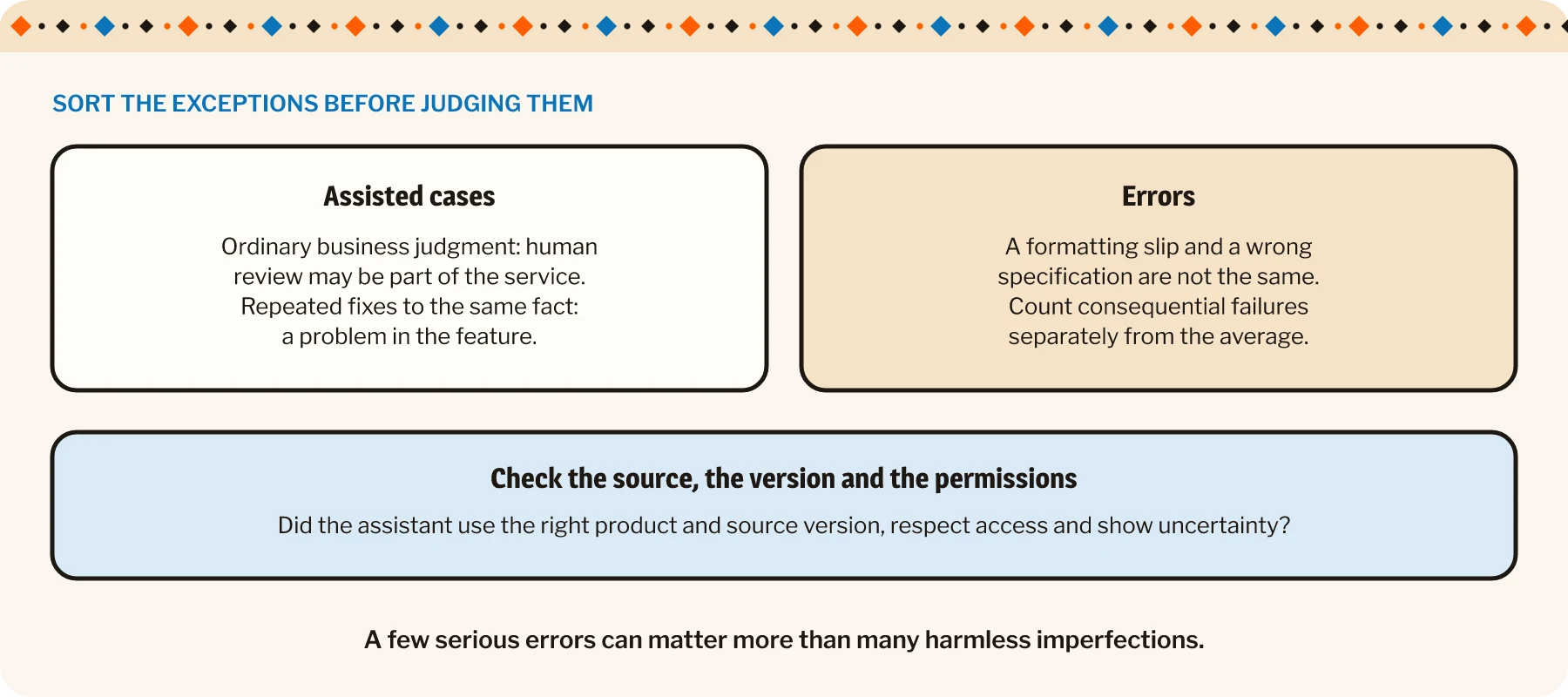
Review the twenty assisted cases. Perhaps some needed ordinary business judgment, while others required someone to locate the correct source or remove an unsupported claim.
Those categories point to different changes. Human review may be an intentional part of the service. Repeated corrections to the same product fact suggest a problem worth addressing in the feature.
Record the effort involved at an appropriate level. Count review and correction work, not only the model request. A feature that produces a paragraph can also produce a small unpaid sequel for the person checking it.
Curious what an AI agent could do for your team? See our AI agent services.
Treat error consequences separately
A minor formatting problem and a wrong specification should not disappear into the same average quality score.
Define consequential failure types for the task and inspect them directly. Check whether the assistant used the right product and source version, respected access permissions and made uncertainty visible.
A small number of serious errors can matter more than a large number of harmless imperfections. The reporting should make that distinction understandable to the person responsible for the service.
Compare the result with a meaningful baseline
To judge the feature, establish how comparable inquiries were handled before and what a suitable outcome looked like.
Account for differences in task difficulty and the people using the process. A comparison between simple AI requests and complicated historical support cases will give the presentation a surprisingly easy afternoon.
For the sample assistant, I would look at usable completion, human intervention, unresolved work and important error categories. Include the relevant operating costs and support requirements without assuming that fewer visible steps automatically mean a better result.
Related read: An AI agent needs a better finish line than “Done”.
The customer-facing effect matters too. Does the final information answer the inquiry correctly? Are clarifications still needed? A satisfied staff user is a useful signal, alongside the quality of what reaches the customer.
| Why it matters | |
|---|---|
| Usable completion | A fluent draft is not complete if the product information is wrong or missing |
| Human intervention | Shows the review and correction work the feature still needs |
| Unresolved work | A sensible refusal, poor retrieval or a confusing interface each mean something different |
| Consequential errors | A wrong specification matters more than a formatting slip |
| Operating cost and support | Fewer visible steps do not automatically mean a better result |
| What reaches the customer | Whether the final answer is correct and complete |
Review the incomplete cases with similar care. Some may reflect a sensible refusal to guess. Others may reveal poor retrieval, a tool failure or a confusing interface. An incomplete task is a result to understand, rather than an automatic verdict on the whole feature.
Keep the model, instructions and workflow versions identifiable when comparing periods. After a change, rerun representative evaluations and inspect whether the important failure types improved.
The evaluation literature provides useful methods, but the business still has to choose what a good result means for its own task. That definition should be clear enough for staff and leadership to discuss together.
Popularity earns the feature another look. A useful review establishes whether it helps people finish the right work, how much support it needs and where it should improve.
The assistant can keep its fans. It should also bring something useful to the meeting.