
AI Search Still Uses SEO Fundamentals
In digital marketing, new terms like Generative Engine Optimization (GEO), AI Optimization (AIO) and AI Search are getting attention. These buzzwords promise to redefine how businesses achieve visibility on AI search platforms, such as Google’s Gemini, ChatGPT, or Perplexity. They suggest a big shift in search engine optimization, urging companies to adopt specialized strategies to stay competitive.
However, at Zulu Shack Creative, we believe the hype surrounding GEO and AIO is largely overstated. The core principles of SEO, which include creating high-quality content, optimizing technical performance, and building authority, remain as effective today as they were over a decade ago. In this article, we’ll unpack why these trendy labels are merely repackaged SEO and how focusing on proven strategies ensures sustainable success in 2025 and beyond.
Is AI Search Taking Over Search in 2026?
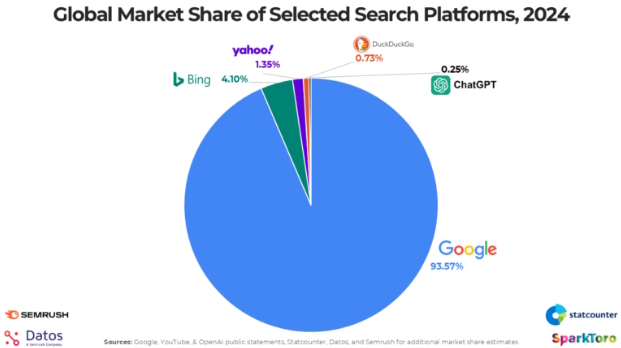
ChatGPT (and other AI search platforms) use is growing, but new user adoption has also slowed down tremendously over the past 12 months. Google’s search market share has remained stable for the last decade, despite what you may have heard on LinkedIn.
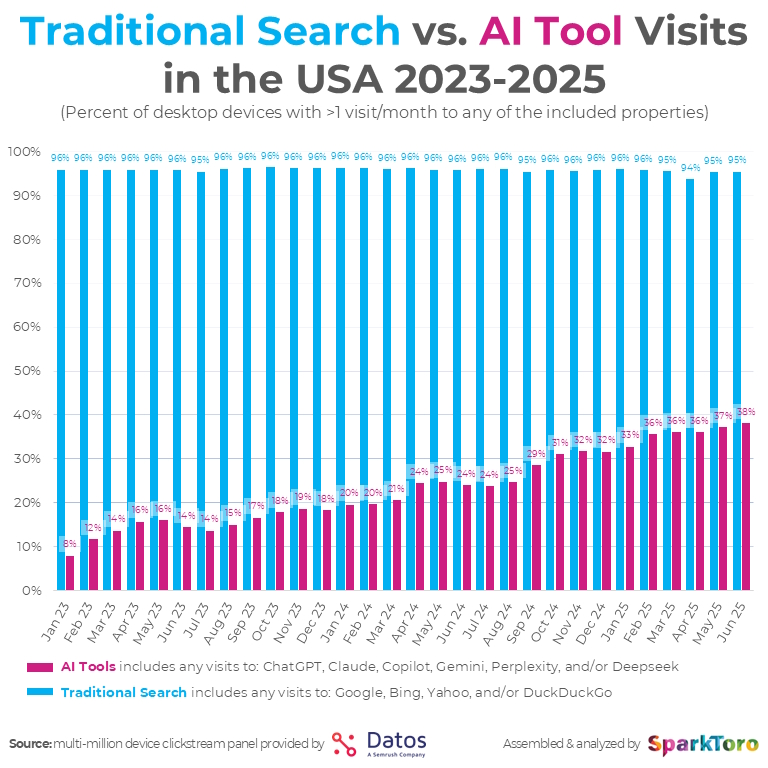
Google still gets roughly ~373 times as many searches as ChatGPT based on 2024 data. To put it in perspective, for every 37.5 million search-like chats that happen on ChatGPT, Google handles 14 billion searches.
The Origins of Modern SEO: A Look Back
To understand why GEO and AIO don’t represent a revolution, it’s worth revisiting a pivotal moment in search history: Google’s Hummingbird update in 2013. This update marked a turning point by introducing semantic search, enabling Google to interpret the intent behind user queries rather than relying solely on exact keyword matches. For example, a search for “best Italian restaurant nearby” began delivering results based on context, location, and relevance, powered by natural language processing (NLP). This technology is a precursor to today’s large language models (LLMs).
Hummingbird also introduced features like the Knowledge Graph and autocomplete, which laid the groundwork for the AI search experiences we see today. These advancements shifted SEO’s focus from keyword stuffing to creating content that genuinely serves users. Fast-forward to 2025, and AI-generated search results, including Google’s AI Overviews or ChatGPT’s conversational responses, build on the same principles: delivering accurate, authoritative, and user-focused information. GEO and AIO may sound cutting-edge, but they’re rooted in the same SEO fundamentals established years ago.
Search Intent Still Matters in AI Search
Search intent remains one of the most important factors to consider when doing SEO. The main types of search intent are transactional (users looking to buy), informational (users looking for information on something), and commercial (users doing research because they want to buy a product or service).

Most searches on ChatGPT have informational intent. 95% of ChatGPT users still use Google, while only 14.3% of Google users also visit ChatGPT. What this means is that someone might ask for information regarding a product or service on ChatGPT, but that user will then head to Google when they are ready to do their transactional search.
Decoding GEO and AIO: What’s Really New?
The terms GEO and AIO have emerged as marketing agencies attempt to differentiate their services in a crowded digital landscape. GEO, for instance, claims to optimize content specifically for generative AI search platforms that produce synthesized answers rather than traditional search result lists. AIO, similarly, suggests tailored strategies for AI search platforms. But when you peel back the layers, these approaches rely on the same tactics SEO professionals have used for years.
Let’s be clear: Search hasn’t changed. How Google displays search results has changed. Google will keep changing how it displays search results in the future.
For example, when Google’s AI Overview generates a summary for a query like “how to improve website traffic,” it pulls from top-ranking pages optimized with standard SEO techniques: targeted keywords, clear formatting, and authoritative backlinks. Similarly, ChatGPT’s responses often cite or paraphrase high-quality sources that rank well in traditional search. The processes may differ (retrieval versus generation), but the inputs that drive success remain consistent.
We’ve seen agencies pivot from ‘social media’ to ‘content marketing’ to ‘growth hacking.’ GEO and AIO are just the 2025 version of that. It’s new paint on an old house. Clients get results from a strong foundation, not from chasing the latest acronym. We focus on the foundation.
Ryan Kemp
Co-Founder at Zulu Shack Creative
The Pitfalls of Chasing Buzzwords
The allure of GEO and AIO lies in their promise of future-proofing your digital presence, but falling for the hype can lead to costly missteps. Many agencies use these terms to capitalize on businesses’ fears of being left behind in an AI search world. The result is that companies invest in expensive, “specialized” services that deliver little more than standard SEO practices wrapped in trendy jargon.
Consider a practical example: a business owner hears that GEO is essential for ranking on AI search platforms. They hire an agency promising GEO expertise, only to receive a strategy centered on keyword optimization, link building, and site speed improvements. These are core SEO tactics that they could have implemented at a lower cost. Worse, focusing on buzzwords can distract from addressing real gaps in a website’s performance, such as outdated content or poor mobile usability.
The rapid evolution of AI technology means that chasing trends is a losing game. Algorithms change frequently, but the principles of delivering value to users through relevant content, technical excellence, and trustworthiness endure. By prioritizing these fundamentals, businesses can adapt to any search environment without wasting resources on fleeting fads.
The Pillars of Effective SEO in 2025
To achieve and maintain visibility, whether on traditional search engines or AI search platforms, focus on these time-tested strategies:
- Craft Intent-Driven Content
Content remains the heart of SEO. Write articles, guides, and product pages that directly answer your audience’s questions with clarity and authority. For example, a blog post titled “How to Choose the Best CRM for Small Businesses” should provide actionable advice, backed by data or examples, to address specific pain points. AI engines, like their predecessors, favor content that is concise, well-structured, and rich with relevant information. - Prioritize Technical Optimization
A website that loads slowly, isn’t mobile-friendly, or has broken links will struggle to rank, regardless of the search platform. Invest in technical SEO to ensure your site is accessible and user-friendly. Tools like Google’s PageSpeed Insights can help identify areas for improvement, such as image compression or server response times. A seamless user experience is a universal ranking factor. - Build and Maintain Authority
Earning backlinks from reputable websites signals to search engines and AI models that your content is trustworthy. Strategies like PR link building, guest blogging, industry partnerships, or creating shareable resources (such as infographics or research reports) can boost your authority. For instance, a backlink from a respected industry publication carries more weight than dozens of low-quality links. - Leverage Keyword Research
Understanding what your audience searches for is critical. Use tools like SEMrush or Ahrefs to identify high-value terms with strong search intent. Doing a few Google searches yourself can also help you understand what users are typing into Google. Incorporate these keywords naturally into your content, headers, and meta descriptions to improve discoverability. - Monitor and Adapt
SEO is not a set-it-and-forget-it process. Regularly audit your website’s performance, track keyword rankings, and analyze user behavior to refine your strategy. AI search may evolve, but staying data-driven ensures you can pivot without losing ground.
Why ZuluShack Is Your Trusted SEO Partner
At ZuluShack, we don’t rely on buzzwords to drive results. Our SEO strategies are grounded in data, experience, and a commitment to your success. We offer:
- Customized Content Plans: We create content that resonates with your audience and aligns with their search intent, ensuring maximum relevance.
- Comprehensive Technical Audits: Our audits can identify problem areas on any website. Our team optimizes your website for speed, mobile compatibility, and crawlability, enhancing user and search engine experiences.
- Strategic Authority Building: We secure high-quality backlinks to position your brand as an industry leader.
- Advanced Keyword Strategies: Our research uncovers the terms that drive traffic and conversions for your business.
- Ongoing Performance Tracking: We monitor results and adapt strategies to keep you ahead of the curve.
Embrace What Works, Ignore the Noise
The next time you hear about GEO, AIO, or another flashy acronym, approach it with a critical eye. SEO’s core mission, delivering value to users through relevant, accessible, and trustworthy content, remains unchanged. By focusing on proven strategies, you can achieve sustainable visibility across any search platform, from Google to emerging AI tools. At Zulu Shack Creative, we’re here to help you navigate the digital landscape with clarity and confidence. Ready to elevate your search performance? Contact us today to start building a strategy that delivers lasting results.

AI Agent vs Chatbot for Business: Which Drives Better Conversions?
In a world where speed and personalization rule, basic chatbots just don’t cut it anymore. If you want real conversions and loyal customers, it’s time to think bigger. Let’s break down why AI agents are taking over digital marketing, and how they’re helping smart businesses boost engagement, streamline workflows, and drive serious results.
Key Takeaways
- AI agents are leaving chatbots in the dust when it comes to smarter conversations and better conversions.
- AI agents use real-time data to make every interaction feel tailor-made.
- Over half of businesses are already jumping on the AI agent train, and it’s easy to see why.
- Running multiple AI agents lets you automate more, work faster, and keep customers happy at every step.
- You don’t need to be a tech wizard to build one, with the right tools, AI agents are easier to launch than ever.
The Evolution: From Chatbots to AI Agents
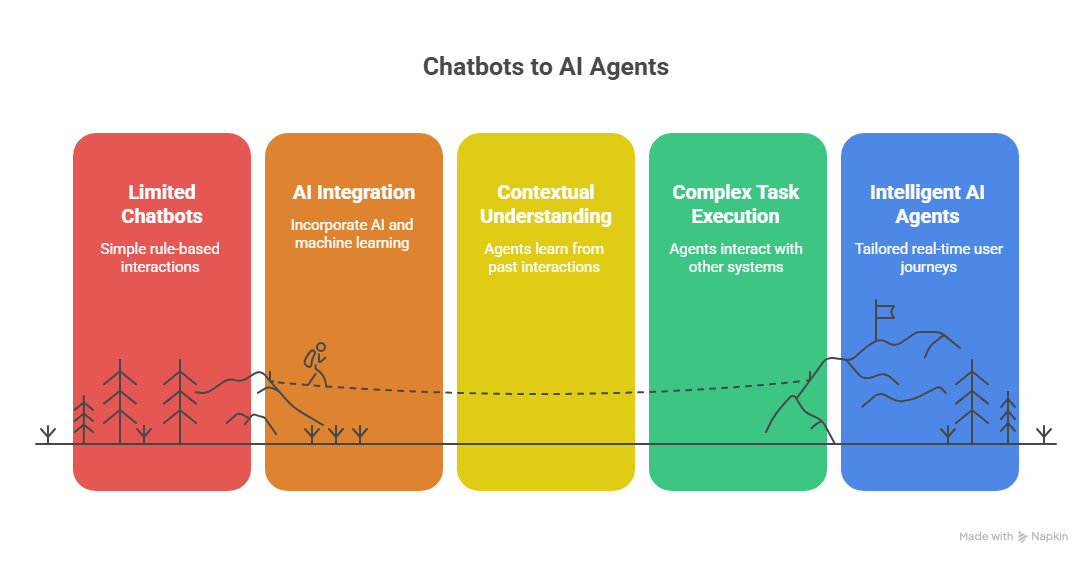
Chatbots were the cool kids on the block for a while. You clicked on a website, saw that little chat bubble pop up, and you thought, “Wow, instant help!”
But then it became clear that these bots weren’t all that smart.
Ask one slightly off-topic question, and suddenly you’re in a never-ending loop of canned responses.
That’s because traditional chatbots are built on pre-defined rules and decision trees. They can handle simple tasks like answering FAQs or booking appointments, but that’s about it.
Now let’s talk about the new generation: AI agents.
These aren’t your typical bots. AI agents are powered by artificial intelligence, large language models, machine learning, and natural language processing.
They don’t just follow scripts, they understand context, learn from past interactions, perform complex tasks, and interact with other systems and tools.
Think of chatbots as traffic cops directing you down one of three roads.
Now picture AI agents as highly trained tour guides who tailor your journey in real-time, based on your preferences, history, and goals.
What Is an AI Agent?

An AI agent is a computer program designed to understand natural language, analyze customer input, and take action based on that understanding.
It’s like giving your business a digital brain that can think, learn, and interact intelligently with your customers and systems.
Using tools like large language models, AI agents can automate workflows, generate personalized outputs, and perform tasks that would normally require human intervention.
They don’t just respond, they solve real-world problems and work across external tools, platforms, and databases.
At Zulu Shack Creative, we believe AI agents are the most powerful AI solutions available to marketers today.
They’re designed to be proactive, responsive, and completely aligned with business goals. And the best part? They keep learning and getting smarter.
AI Agent vs Chatbot vs Conversational AI: Clearing Up the Confusion
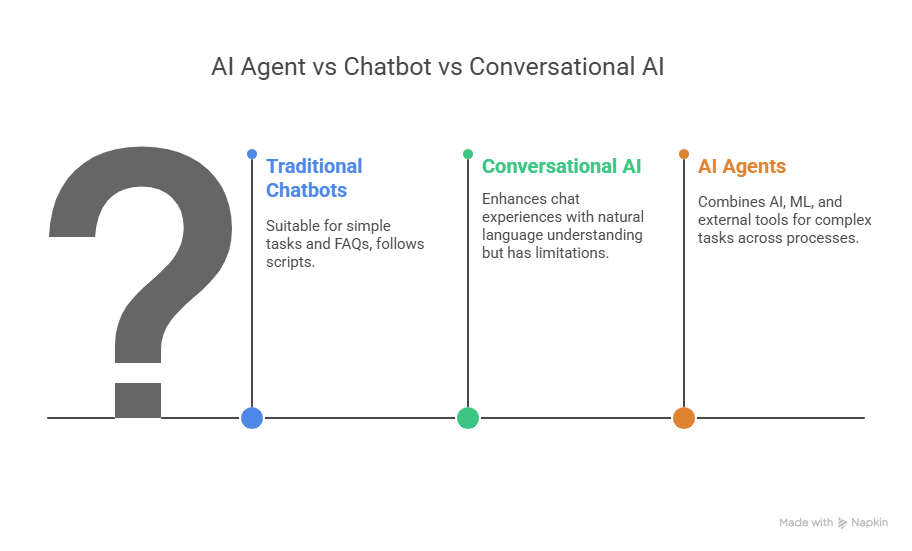
Let’s break it down because these terms get mixed up a lot:
- Traditional Chatbots follow scripts and handle simple tasks like FAQs.
- Conversational AI adds natural language understanding for better chat experiences but still has limitations.
- AI Agents combine conversational AI, machine learning, decision making, and access to external tools to perform complex tasks across business processes.
So when we say “AI agent,” we mean something that goes beyond chat. We’re talking about digital workers with real problem-solving power.
AI Agent vs Chatbot: Who’s Winning the Conversion Game?

Let’s put these two side by side and see who’s really delivering on the promise of better customer experiences and more conversions.
1. Understanding What Customers Really Mean
Chatbots can only do what they’re programmed to do. If your customer types something unexpected, they might get stuck or receive a confusing response.
AI agents use natural language understanding and contextual awareness to interpret what your customer actually means, even when it’s not perfectly phrased.
They read between the lines and respond in a way that feels human and helpful.
Winner: AI agents
2. Performing Complex Tasks
Chatbots are great for quick answers, but ask them to pull your invoice history or reschedule an appointment across two platforms, and they’re lost.
AI agents can perform complex tasks like updating customer data, integrating with CRMs, triggering email workflows, or generating proposals, all within a single conversation.
Winner: AI agents
3. Personalizing the Experience
Customers want to feel like they’re talking to someone who knows them. Chatbots don’t have memory. AI agents do.
AI agents pull in historical data, customer preferences, and even insights from previous chats to personalize every interaction.
That means customers get answers faster, and they feel seen.
Winner: AI agents
4. Speeding Up Conversions
Chatbots often act as middlemen, passing off leads to real people to follow up.
AI agents close the loop.
They qualify leads, answer detailed product questions, schedule demos, and even process transactions.
That means fewer drop-offs and more conversions.
Winner: AI agents
Why Chatbots Just Can’t Keep Up
Look, chatbots still have a role to play. They’re cheaper, easy to implement, and useful for really basic tasks.
But when customer expectations are high and the competition is fierce, you need something more. You need an AI agent that can:
- Understand customer language
- Personalize the conversation
- Complete tasks across platforms
- Improve with every interaction
In short, you need intelligence, not just automation.
Let’s Talk Numbers
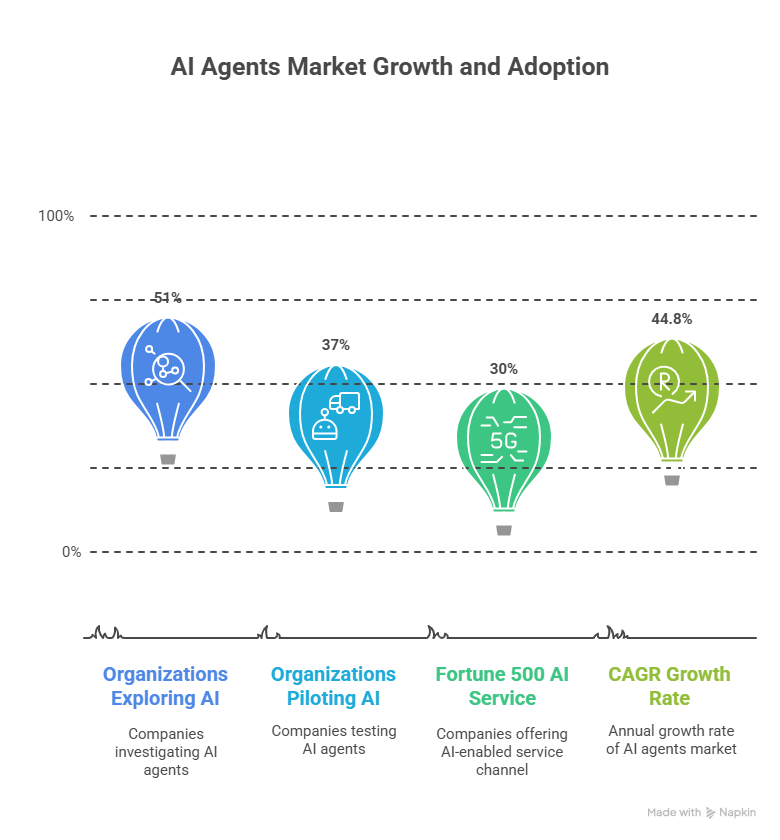
Still wondering if AI agents are worth the investment? Take a look at the trends:
- The AI agents market is set to explode from $5.1 billion in 2024 to $47.1 billion by 2030, growing at a whopping 44.8% CAGR. That’s not just growth, it’s a full-on rocket launch. [Source]
- A KPMG study reveals that 51% of organizations are already exploring AI agents and 37% are piloting them. [Source]
- According to Gartner, 30% of Fortune 500 companies will offer service through a single, AI-enabled channel by 2028. [Source]
This tells us one thing loud and clear: the future belongs to businesses that embrace smart automation and AI-driven experiences.
Why AI Agents Work So Well in Digital Marketing
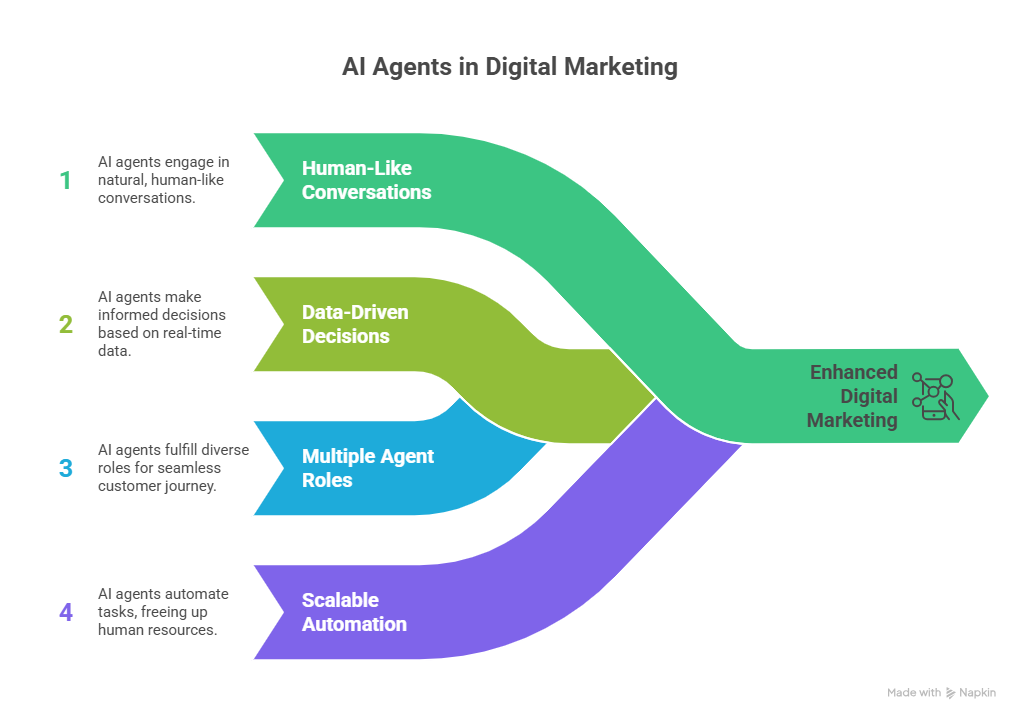
Digital marketing is all about connecting with the right people at the right time in the right way. AI agents are tailor-made for that.
1. Conversations That Feel Human
AI agents use natural language processing and deep learning to understand tone, intent, and context. That means they can handle tricky questions, steer the conversation toward a conversion goal, and adapt their language to suit different personalities.
2. Data-Driven Decision Making
AI agents analyze customer data in real time to identify patterns, segment audiences, and recommend the best next steps. They don’t guess—they know.
3. Multiple Agents, Multiple Roles
Why limit yourself to one agent when you can have several?
With multiple AI agents, you can assign different roles—one for lead gen, another for onboarding, and a third for customer retention. Each one is trained for its specific function and works alongside others to create a seamless customer journey.
4. Scalable Automation
AI agents automate routine tasks, handle repetitive questions, and manage time-consuming processes without breaking a sweat. This frees up your human team to focus on creative, strategic work while the agents keep everything running smoothly.
How to Create an AI Agent (It’s Easier Than You Think)

Building an AI agent sounds like a big job, but we make it simple at Zulu Shack Creative. Here’s how it works:
Step 1: Choose a Use Case
Start by identifying a problem you want to solve. It could be lead qualification, customer support, internal workflow automation, anything that slows your team down.
Step 2: Train with Real Data
Feed your AI agent real-life examples, historical data, user questions, and brand tone. This helps it learn how to respond like a true team member, not just a robot.
Step 3: Connect to External Systems
Your AI agent becomes a powerhouse when you integrate it with CRMs, email platforms, and databases. This allows it to access the information it needs to complete tasks without human intervention.
Step 4: Launch and Optimize
Once live, your AI agent starts learning from every conversation. You can tweak responses, improve performance, and scale based on real results.
And don’t worry, our team is with you every step of the way.
The Final Verdict
Let’s put it all together.
| Feature | Chatbot | AI Agent |
|---|---|---|
| Understands Natural Language | Sometimes | Yes |
| Learns from Past Interactions | No | Yes |
| Performs Complex Tasks | No | Yes |
| Integrates with External Systems | No | Yes |
| Personalizes Responses | Limited | Yes |
| Automates Workflows | Only Basic | Yes |
| Improves Over Time | No | Yes |
| Drives Conversions | Not Consistently | Absolutely |
AI agents win in every category that matters for modern businesses.
At Zulu Shack Creative, we build AI agents that are trained to solve real problems, boost performance, and work hand-in-hand with your team.
Ready to Build Smarter Conversations That Convert?
Let’s make your brand unforgettable. Whether you’re just getting started with AI agents or ready to scale, Zulu Shack Creative is here to help you create, launch, and optimize AI-powered solutions that actually work.
Contact us today and let’s build something brilliant together.
Frequently Asked Questions
How can AI agents help automate workflows across different departments?
AI agents can connect with various business processes, like sales, customer service, and operations, to automate routine tasks, reduce manual input, and improve overall efficiency.
Are AI agents suitable for small businesses or just enterprise-level companies?
Absolutely. AI agents can be scaled to fit any size business and are especially helpful for small teams looking to streamline complex workflows and improve customer experience with limited resources.
Can multiple AI agents work together in the same system?
Yes. Using multiple AI agents, each focused on specific functions and to perform tasks like lead scoring, onboarding, or support, can enhance performance across the customer journey without overlapping tasks.
How does natural language processing improve customer interactions?
Natural language processing enables AI systems to interpret human language, understand customer input, and respond in a way that feels natural, making interactions smoother and more satisfying.
What role does machine learning play in improving agent performance over time?
Machine learning allows AI agents to identify patterns from historical data, adapt to user inputs, and continuously optimize how they perform complex tasks and respond to real-world problems.
Can AI agents interact with external tools like CRMs or customer management systems?
Yes. Integrating with external systems allows AI agents to access customer data, update records, and take action based on user requests in real time.
Storytelling That Sells: The Power of Content Writing For Marketing
In today’s world, people are bombarded with sales pitches, from sponsored posts in their feed to flyers tucked under their wipers. And let’s be honest, the last thing anyone wants is another cringey sales line. That’s exactly why content marketing matters, it cuts through the noise with real value, and we’re here to show you how content writing can become your business’s most powerful asset.
Key Takeaways
- Content writing is the foundation of marketing that builds trust and drives real results.
- A strong content strategy helps you connect with your target audience in authentic ways.
- Great content informs, inspires, and supports long-term customer relationships.
- Content marketing is 62% more cost-effective than outbound methods and generates three times more leads.
- You don’t need a marketing unicorn, just a warrior team like Zulushack Creative to get it done right.
What Is Content Writing, Really?
Content writing for marketing is the art (and science) of using words to convey value. But it’s not just slapping text on a webpage. It’s writing with purpose, and with your intended audience in mind. [Source]
From blog posts to social media posts, video scripts to email marketing, the goal is simple: create compelling content that helps, educates, entertains, or inspires.
The more relevant, the better. When paired with a strong content marketing strategy, it becomes one of the most powerful tools in your marketing funnel.
Content writing and marketing together form the backbone of how your business shows up online.
It supports brand voice, builds relationships, and fosters long term connections with your potential customers.
Why Content Marketing Works (And Always Will)
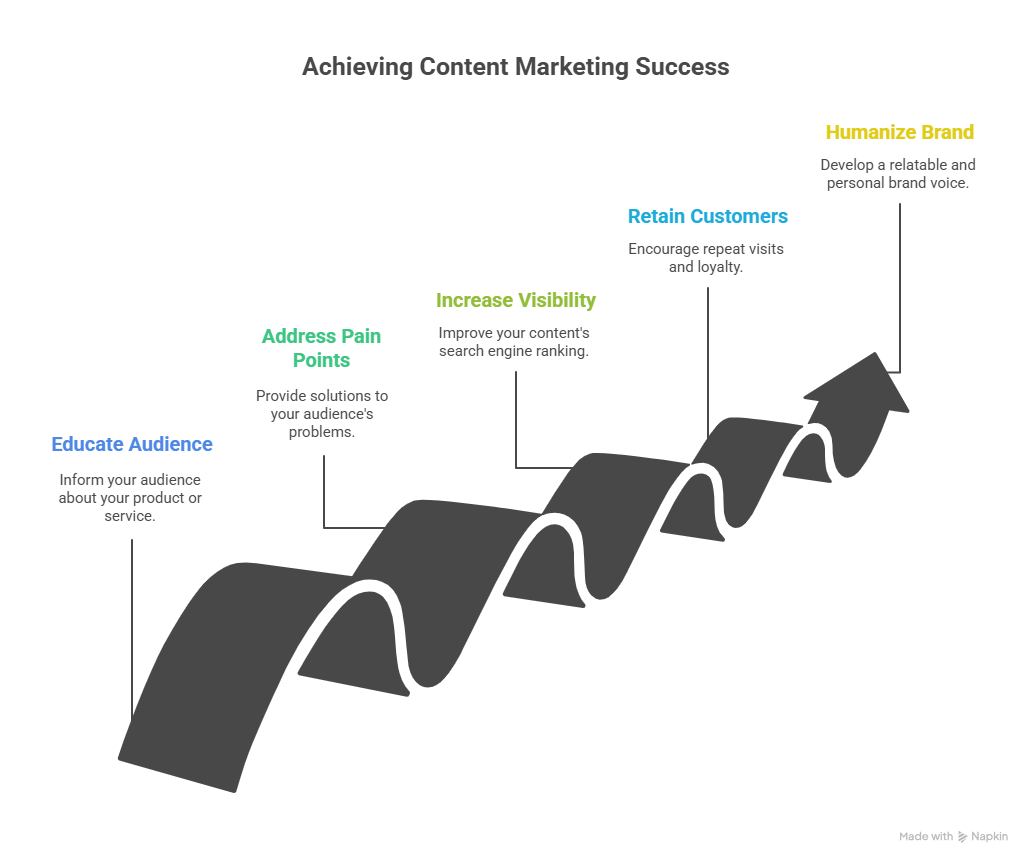
If you’ve ever wondered why content marketing matters in the age of TikTok trends and paid ads, here’s the truth: content builds trust and trust drives sales.
Here’s what great content writing can do for your business:
- Educate your target audience about your product or service
- Address pain points and provide solutions
- Increase visibility across search engines
- Keep people coming back for more (hello, customer retention!)
- Humanize your brand voice
Unlike one-time ads, content marketing efforts stick around.
A well-written blog post can keep generating organic traffic for years.
An engaging YouTube video can live rent-free in someone’s head and social media platforms love shareable content that sparks conversation.
The Role of Content Writing in Your Marketing Strategy

Think of your marketing strategy as a wheel. Your product or service is the hub, and each spoke represents a channel: social platforms, email, paid ads, blog content, and so on.
Content writing fuels every one of those spokes.
Without high quality content, none of the other parts work efficiently.
Content creation powers every campaign.
Whether you’re launching a new product or building brand awareness, writing with clarity and emotional impact is your superpower.
Your brand’s content marketing strategy should focus on both short-term wins and long-term relationships.
That means combining SEO content with emotionally resonant storytelling to capture both clicks and hearts.
What Makes Great Content? (Spoiler: It’s Not Just Grammar)
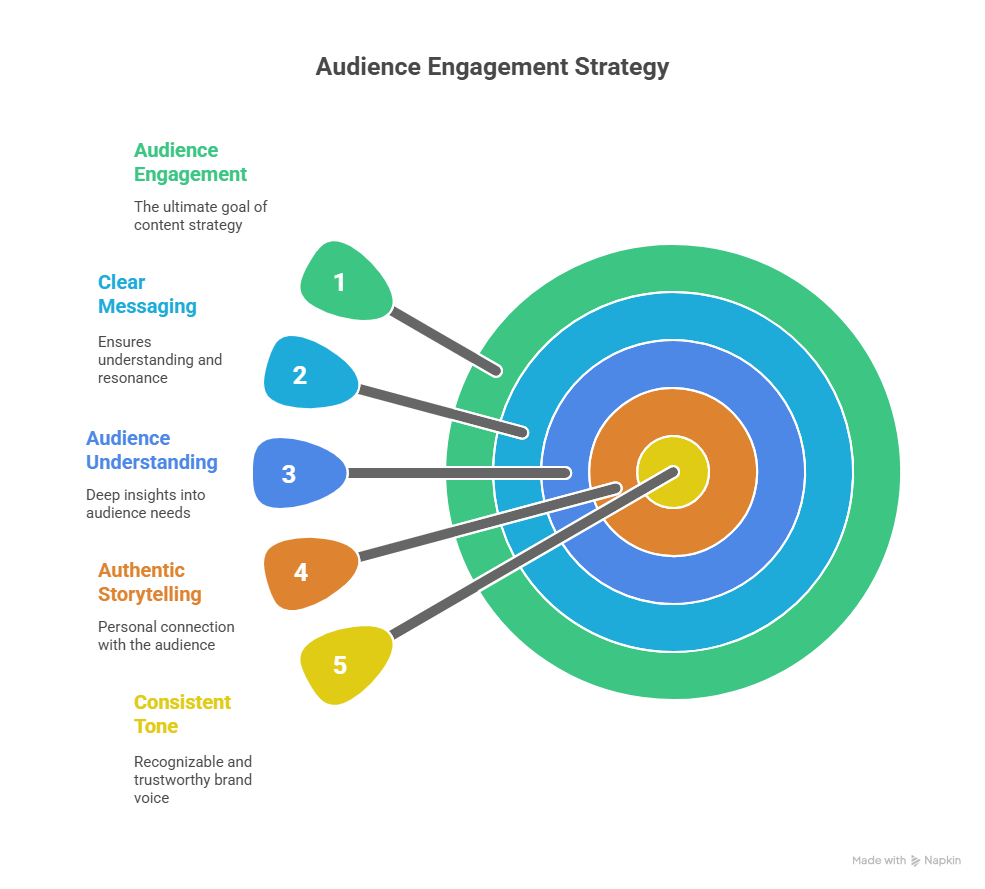
Let’s get real, no one wants to read a boring wall of text. The secret to engaging content lies in:
- Clear messaging
- A deep understanding of your audience’s needs
- Authentic storytelling
- Consistent tone across all content formats
And let’s not forget the technical side. To really shine in digital marketing content, you need to incorporate SEO, use persuasive language, and structure your content for readability (yes, bullet points help!).
Great writers know how to simplify complex ideas. They make the hard stuff sound easy and turn everyday experiences into relatable gold.
Understanding the Content Writing Process

To create content that converts, you need a clear process that takes you from idea to execution.
Here’s how we do it at Zulushack:
1. Know Your Audience
Before writing a single word, define your intended audience. What do they care about? What keeps them up at night? What online content do they consume?
2. Do the Research
Get in depth with your industry trends, competitors, and what already exists out there. This ensures your content stands out, and provides accurate information.
3. Choose the Right Content Formats
Not everything needs to be a blog post. Sometimes it’s a short-form YouTube video. Other times it’s marketing copy for a landing page or even press releases.
Select formats that align with your audience’s behavior.
4. Write With Purpose
Every sentence should move the reader toward a goal, whether it’s to read more, click through, or take action.
5. Edit for Clarity and Voice
Content writers are storytellers, but they’re also editors. Make sure your writing reflects your brand voice and is free of fluff or jargon.
6. Incorporate SEO Strategically
Keywords help search engines understand your content, but they should never come at the cost of readability.
SEO content works best when it’s naturally woven into valuable content.
Content Writing for Marketing: A Match Made in Conversion Heaven
Marketing and writing are no longer two separate jobs.
In fact, content marketers are some of the most in-demand pros in the digital space because they bring the best of both worlds: strategy and storytelling.
Your blog writing is not just about words, it’s a key touchpoint in the customer journey. And great content is what moves people through the marketing funnel from curious browsers to loyal buyers.
Whether you’re creating online content for your website, writing blog posts, or crafting social media posts that speak to your community, every word matters.
How to Create Compelling Content That Converts

Ready to level up your content marketing efforts? Here are some tips from our Zulushack team:
Speak to Pain Points
People are always looking for answers. Address your audience’s pain points early and show them you understand their struggles.
Use Emotional Impact
Marketing works when it makes people feel. Use stories, examples, and visuals to make your writing relatable and emotionally resonant.
Be Clear, Not Clever
Sure, puns are fun. But clarity always wins. Make sure your content writing communicates value without making your reader work for it.
Optimize for Humans First, Search Engines Second
Yes, we love SEO. But real people are the ones reading your blog content. Write like you’re having a conversation, not submitting a research paper.
Use Multiple Content Formats
Mix it up! Blog posts, social media, video content, podcasts, press releases, they all have a role to play in building your brand.
Blog Posts Still Matter (Here’s Why)
You might be thinking, “Do people even read blogs anymore?”
Short answer: yes. Especially if they’re well-written, helpful, and optimized for mobile.
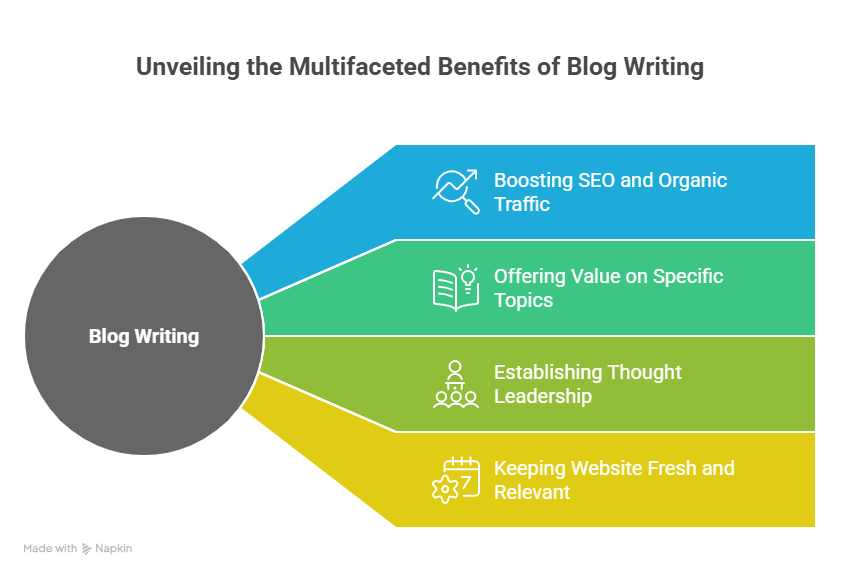
Blog writing plays an essential role in your content marketing strategy by:
- Boosting SEO and organic traffic
- Offering value on specific topics
- Establishing thought leadership
- Keeping your website fresh and relevant
And the best part? A single blog post can be repurposed into multiple other forms, like social media posts, email newsletters, or even video scripts.
Content Marketing and SEO: The Power Couple

If storytelling is the heart of your marketing, SEO is the brain. Incorporate SEO into your content writing process by:
- Using keywords your audience is already searching for
- Optimizing headlines, meta descriptions, and subheadings
- Linking internally and externally to build authority
The result? More visibility in search engines, more clicks, and more conversions.
The Rise of Video and Visual Storytelling

Let’s not forget how powerful video content has become.
A well-scripted YouTube video, paired with strong visuals and storytelling, can outperform even the best-written text based content.
Content marketers today must think beyond the blog and look at the full spectrum of content creation. That includes:
- Instagram reels and TikToks
- YouTube video content
- Webinars and live streams
- Behind-the-scenes clips
- Social media stories
But here’s the thing, writing is still the backbone. Even videos need scripts. Even tweets need hooks. That’s why content writing remains an essential part of every digital marketing strategy.
Social Media and the Speed of Connection

We’ve all heard it: social media moves fast.
But that’s exactly why your written content matters more than ever.
You have seconds to grab attention, and you need to do it with clarity and emotion.
Use social media platforms to:
- Share bite-sized valuable content
- Drive traffic to your blog posts
- Start conversations within online communities
- Test ideas before building full campaigns
Your social media strategy should align with your content marketing efforts and feel consistent across platforms.
Writing That Builds Long-Term Relationships

Content isn’t just about clicks, it’s about connection.
Your primary purpose is to build relationships that last. With consistent, high quality content, you can:
- Increase customer retention
- Build brand loyalty
- Turn readers into advocates
Think of your blog content, email marketing, and social media posts as relationship-building tools, not just marketing work.
Every piece of content should serve your audience first, and your brand second.
Why You Need a Content Marketing Partner Like Zulu Shack Creative
Let’s be honest, modern marketing teams wear a lot of hats.
You need strategists, copywriters, SEO nerds, social media buffs, designers, video editors, and data analysts… all working in sync.
It’s no wonder businesses are out there searching for the ever elusive “marketing unicorn” who can do it all.
But here’s the truth: unicorns don’t exist and trying to stretch your internal team that thin usually leads to burnout and bland content.
That’s where a marketing partner like Zulu Shack Creative steps in.
We’re not unicorns, we’re warriors. Like our name suggests, we bring the strength, precision, and relentless spirit of the great Zulu warriors to everything we do.
We roll up our sleeves, dive into your brand, and bring our full-stack content marketing squad to the table.
From SEO-optimized blog writing to scroll-stopping social media posts, persuasive email campaigns, and punchy video scripts, we cover it all.
So instead of chasing magic, let’s build something real, powerful, and results-driven together.
Real Talk: Is Content Marketing Worth the Investment?
Short answer? Yes. Long answer? Absolutely, and here’s why.
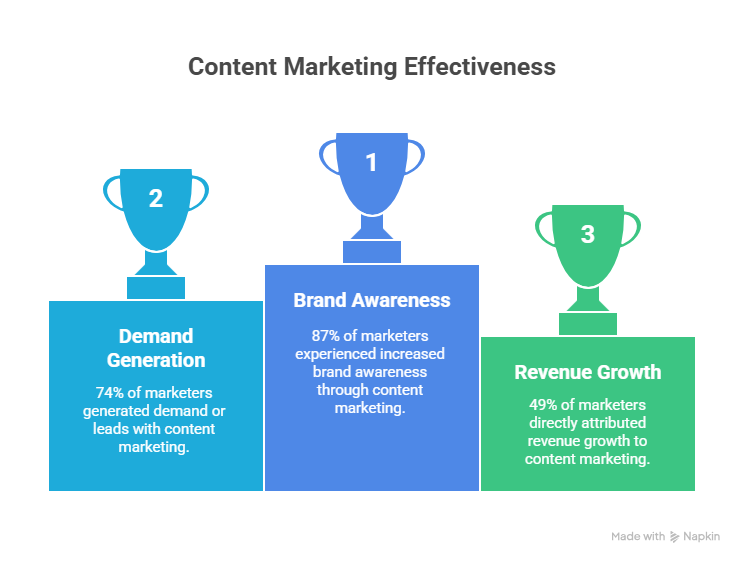
The 2025 Content Marketing Institute (CMI) study confirms what we see every day at Zulushack Creative: content marketing delivers.
According to their findings [Source]:
- 87% of marketers saw increased brand awareness
- 74% generated demand or leads
- 49% directly attributed revenue growth to their content marketing efforts
That’s not just impact, it’s ROI you can feel.
If you’re still weighing content against traditional tactics, consider this: content marketing is 62% more cost-effective than outbound methods and can generate three times more leads. [Source]
That means you’re not only spending smarter, you’re getting better results.
When done right, content marketing doesn’t just fill a content calendar, it fuels growth, builds trust, and keeps your brand top of mind in a crowded digital world.
Final Thoughts: Writing Is Marketing
Content writing isn’t just part of your marketing strategy, it is your marketing strategy. It’s how you educate, persuade, entertain, and sell.
From press releases to blog posts, from social media posts to YouTube scripts, storytelling is the glue that holds your brand together.
At Zulu Shack Creative, we know that great content writing can turn browsers into buyers, followers into fans, and casual clicks into long-term relationships.
It’s how we build brands that matter.
If your mythical unicorn is battling to meet your content marketing goals, then turn to us here at Zulu Shack Creative!
Contact our Zulu Shack Creative team and let’s take your content marketing to the next level.
Frequently Asked Questions
What’s the difference between content writing and marketing copy?
While both aim to engage your intended audience, content writing focuses on providing valuable content through formats like blog posts or guides, while marketing copy is often short-form and designed to prompt immediate action.
How do I choose the best content formats for my brand?
It depends on your target audience, goals, and platform. Some audiences prefer video content and social media posts, while others respond better to long-form blog content or in depth email marketing.
Can content writing help with customer retention?
Absolutely. Creating high quality content that continuously addresses your audience’s pain points helps build trust, keeps them engaged, and encourages long term relationships.
How can I incorporate SEO into my content writing process without ruining flow?
The key is to naturally integrate keywords like “content marketing strategy” or “digital marketing content” without forcing them. Strong content writers know how to balance readability with search engines’ needs.
Why is brand voice so important in content creation?
A consistent brand voice strengthens your message across all social platforms and content marketing efforts, helping your audience recognize, relate to, and trust your content wherever they encounter it.

How Digital Marketing Fuels Lead Generation For Small Business
This blog breaks down how digital marketing helps small businesses consistently generate new leads without spending like big corporations. We highlight proven strategies,SEO, PPC, email marketing, social media, content, and more, that directly support your sales process. If you’re looking to scale smarter, this guide shows you where to start and what works.
Key Takeaways
- Digital marketing helps small businesses compete without overspending.
- SEO and PPC bring in quality leads from day one.
- Social and content marketing build brand trust.
- Email and lead magnets warm up cold traffic.
- Analytics and funnel tweaks turn traffic into revenue.
Why Digital Marketing?
Let’s be real, small businesses don’t have unlimited cash to throw at marketing. You’ve got to make every dollar hit like a heavyweight punch. That’s where digital marketing changes the game.
You’re not just getting seen. You’re tracking clicks, testing offers, dialing in your messaging, and watching your actual leads roll in. [Source]
Traditional ads? They’re like throwing darts blindfolded. Digital? You’ve got a scope, a target, and the data to back it up.
Whether you’re slinging scissors in a salon, helping folks sort their finances, or running a treatment center that saves lives, digital gets you in front of the right people, without the corporate price tag.
“You don’t need to outspend big companies, you just need to outthink them. The right digital strategy outperforms the biggest ad budgets when it hits the right person at the right time.” – Ryan Kemp, CMO of Zulu Shack Creative
Let’s take a look at the best digital marketing services that will help your small business generate leads.
1. Search Engine Optimization (SEO)
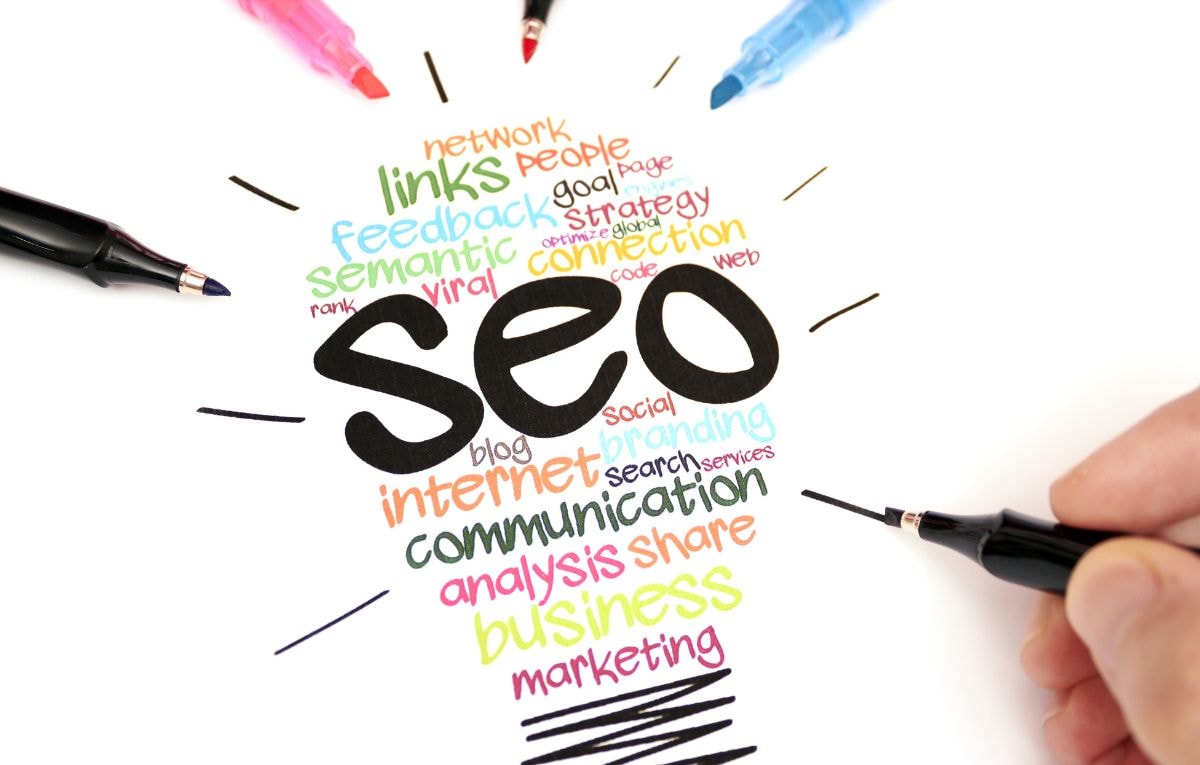
Want to generate leads while you sleep?
That’s what SEO does. It ranks your website on search engines like Google so your potential customers can find you exactly when they’re searching for what you offer.
What works:
- Targeting relevant keywords that match search terms your target audience actually uses.
- Optimizing meta tags, headers, and website content to match user intent.
- Getting listed on Google Maps, local listings, and investing in local SEO.
- Publishing high quality content that ranks for long-tail terms and fills content gaps.
If you’re not doing SEO, you’re invisible.
2. Pay-Per-Click (PPC) Advertising

Need leads fast? That’s what PPC campaigns are built for.
You only pay when someone clicks. With proper PPC management, you can:
- Show up at the top of search results.
- Target your local market or niche markets.
- Control your ad spend.
- Generate quality leads in days, not months.
Run your ads on Google Ads, Bing Ads, and social platforms. Make your dollars work smarter.
When done right, PPC is cost effective, hyper-targeted, and scalable.
3. Social Media Marketing

Everyone’s on social media platforms. Your potential clients? They scroll daily.
That’s your window of opportunity! So much so that a recent Index report stated that 81% of customers say that social media compels them to make spontaneous purchases multiple times a year. [Source]
Use social media marketing to:
- Build brand awareness and social media profiles.
- Post relevant content that answers pain points.
- Run targeted marketing campaigns.
- Leverage influencer marketing and user-generated content.
Not just to get followers but to build trust and attract new customers.
4. Content Marketing

This is how you attract and convert. It’s not done with ads but rather by providing customers and potential customers with helpful and valuable information.
Content marketing creates:
- Blog posts that solve target audience problems.
- Downloadable resources that feed the sales process.
- Video content that builds authority.
- Pages built around relevant keywords your audience searches daily.
Great content keeps website visitors engaged and turns them into customers.
💡Pro tip: Match your content to the funnel: awareness, consideration, decision. Every piece should drive traffic, build credibility, or close the sale.
5. Lead Magnets

Let’s cut to it, people don’t just give away their email addresses anymore. You’ve got to earn that click.
Lead magnets help generate leads by offering something too good to scroll past, think free guides, checklists, calculators, or exclusive offers that solve a specific pain point. [Source]
The goal isn’t to sell right away, it’s to start the sales process by opening a conversation.
When done right, lead magnets filter in quality leads who are actually interested and filter out time-wasters. Whether you’re in financial planning, legal services, or health and wellness, this is where the relationship begins.
Use lead magnets like:
- Checklists
- Mini guides
- Templates
- Tools and calculators
You give. They subscribe. Then your email marketing kicks in.
6. Email Marketing

You’ve got the lead. Now what?
This is where email marketing becomes a lead generation strategy and conversion tool rolled into one.
Forget blasting random messages, smart email campaigns nurture potential customers based on behavior, interests, and timing. [Source]
For small businesses especially, email is cost-effective, scalable, and personal.
It can turn cold leads into warm ones, and warm leads into paying customers. Want to retain existing customers too? Email keeps you top of mind.
Use it to:
- Nurture new leads.
- Re-engage existing customers.
- Move prospects through your sales funnel.
Our top tips are to segment your list, think about what the audience wants to know and add value in every mail sent.
7. Testimonials and Case Studies

Want to turn potential customers into paying customers? Let your existing customers do the talking.
Publish:
- Video testimonials
- Written case studies
- Before/after transformations
- Data-driven success stories
This isn’t about bragging it is about building trust and credibility. Your reputation is a selling point.
💡Pro tip: Include testimonials on key landing pages and email campaigns.
8. Website Analytics

What’s working? What’s not?
Website analytics provide the real answers, with no guessing or fluff.
It shows where website visitors are coming from, which pages drive traffic, and where leads drop off. Without this data, you’re flying blind.
If you’re serious about dialing in your digital marketing efforts, your analytics need to be your best friend.
Every click, bounce, and form fill tells you something about your target audience, use it to sharpen your sales funnel and turn more eyeballs into new leads.
You can’t fix what you don’t track.
Use website analytics to monitor:
- Website traffic sources
- Conversion rates across pages
- Bounce rate and time on page
- What content generates leads
Knowing where website visitors come from and what they do tells you what’s working, and what to cut.
9. Sales Funnel Optimization
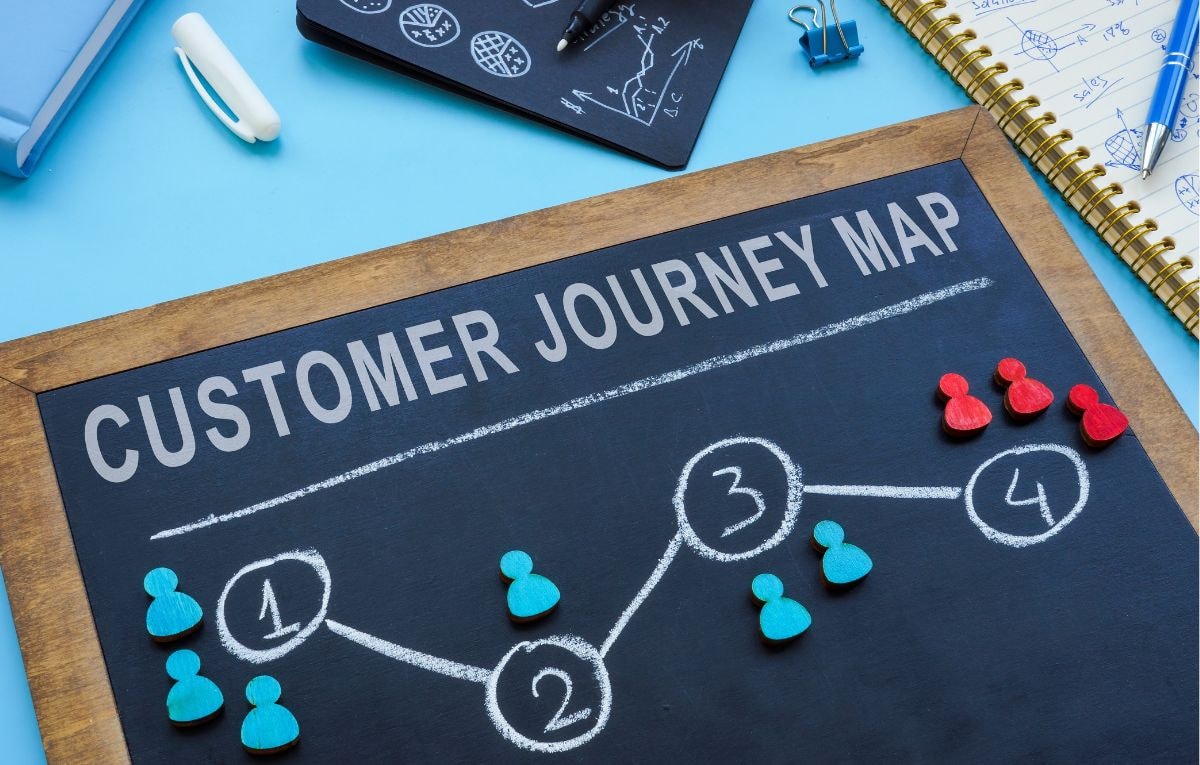
Not everyone converts on the first click. That’s why the sales team needs a funnel that works.
Optimize:
- Top of funnel: social media posts, blog content, lead magnets
- Middle: case studies, retargeting ads, email nurturing
- Bottom: landing pages, booking CTAs, live chat
A strong online presence isn’t just about traffic, it is about creating a sales funnel that converts that traffic into customers.
Why Small Biz Wins with Digital
Digital channels beat direct mail campaigns and random print ads every time. Why?
- They’re measurable
- They’re scalable
- They’re targeted
And you don’t need a follower count like Nike to make it work. You just need the right strategies and the right partner, like Zulu Shack Creative.
For over 12 years, Zulu Shack Creative has helped businesses across industries turn their digital marketing into a high-powered lead generation machine.
If you want a team that builds you a system for steady, high-intent leads? That’s what we do.
Let’s help you create something that actually grows your business! Contact our team today!
Frequently Asked Questions
What’s the most cost-effective way to start with digital marketing?
Start with SEO and content marketing it is low cost, high ROI, and builds long-term results.
How long does it take to see results from digital marketing?
PPC can deliver leads in days, while SEO and content take a few months to build momentum.
Do I need to be on every social media platform?
No. Focus on a few platforms where your audience already spends time.
How do I know if my digital marketing is working?
Use website analytics to track traffic, conversion rates, and lead sources.
Can I generate leads without running paid ads?
Yes. With strong SEO, content, email marketing, and lead magnets, you can build a steady stream of organic leads.

From Clicks to Conversions: How to Use Pay-Per-Click Advertising to Grow Any Business
Struggling to turn clicks into real customers? This blog breaks down how pay-per-click advertising services can help any business, law firms, salons, treatment centers, and financial advisors, among others, generate better leads and measurable results. Learn how PPC ads, budget strategy, and smart campaign management convert attention into action.
“If you’re not controlling your paid traffic, you’re not controlling your growth. Full stop.” — Ryan Kemp, CMO at Zulu Shack Creative
Key Takeaways
- Pay-per-click advertising services deliver fast, trackable ROI for almost any business.
- Effective PPC marketing campaigns hinge on strategic keyword research, compelling ad copy, and data-driven PPC campaign management.
- Your landing page must match the search intent, or you’ll burn through ad spend.
- PPC ads are ideal for industries where every lead counts: law firms, financial advisors, treatment centers, and more.
- A strong PPC marketing strategy combines Google Ads, Bing Ads, remarketing campaigns, and even YouTube ads.
What Makes PPC So Powerful?

Pay-per-click advertising puts you in front of people ready to buy.
Not next week. Not next year. Now.
Compared to organic search engine optimization, PPC advertising services deliver faster results with real-time feedback. That means you can launch today, test tomorrow, and scale what works by next week. [Source]
Whether you’re a rehab treatment center trying to fill your beds or a financial advisor targeting high-net-worth leads, PPC marketing campaigns give you control over every click, conversion, and dollar.
How to Effectively Use PPC Advertising
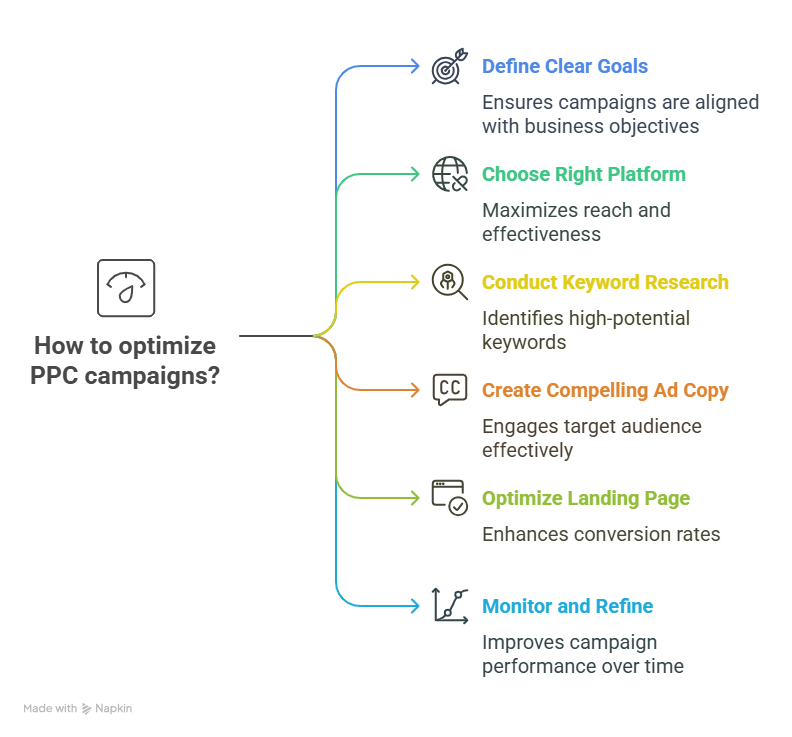
If you’re serious about getting results, you can’t just throw money at PPC and hope it sticks.
To run a winning campaign, you need to [Source]:
- Define clear goals: Are you after leads, calls, purchases, or sign-ups?
- Choose the right platform: Google Ads, Bing Ads, YouTube, or even the Google Display Network?
- Conduct thorough keyword research: Nail the intent, volume, and competition.
- Create compelling ad copy: Speak to your target audience and their pain points.
- Optimize your landing page: Match the ad message and eliminate friction.
- Continuously monitor and refine: Use tools like Google Analytics to double down on what converts.
No matter your industry, this is how paid search campaigns go from costly to profitable.
Why PPC Campaign Management Matters
Running PPC campaigns without a strategy is like throwing money into a fire.
A skilled PPC management company doesn’t just set up ads. They dig deep into:
- Keyword research: To match your ads with the right audience
- Negative keywords: To avoid paying for irrelevant clicks
- Ad copy testing: To create compelling, high-converting search ads
- Conversion tracking: Using tools like Google Analytics
- Ad budget optimization: So you get more leads for less money
At Zulu Shack Creative, our PPC campaign management services are battle-tested across high-stakes industries.
We don’t just increase website traffic. We turn traffic into customers.
What Industries Benefit Most from PPC Marketing Services?

The truth? Almost all.
But some verticals especially thrive with the right PPC marketing strategy:
Law Firms
Whether it’s personal injury or criminal defense, search engine advertising lets you dominate local search engine results and capture high-value leads with urgency.
Treatment Centers
When families search in crisis mode, your paid search ads can be the lifeline that gets seen first. But it needs to match trust with action.
Financial Advisors
Your audience isn’t Googling aimlessly. They search with intent. Proper PPC campaign management helps you target by income, zip code, even keyword sophistication.
PPC Services That Move the Needle
Not all PPC management agencies think long-term.
At Zulu Shack Creative, our pay per click advertising services include:
- Google Ads + Microsoft/Bing Ads
- Remarketing ads + shopping ads
- Audience segmentation for better targeted ads
- In-depth PPC budget forecasting
- YouTube ads + video ads
- Multi-touch remarketing campaigns across platforms
- SEO and PPC integration to support both paid and organic search results
We tailor each campaign to the client. One-size-fits-all is for socks, not advertising strategies.
The Real ROI of Hiring a PPC Management Agency

Here’s where businesses fall short:
- They don’t know how to set a PPC budget
- They underestimate how PPC services can support SEO efforts
- They never optimize their google ads account
- Their ad campaigns lack direction, targeting, or clear metrics
When you work with a real PPC agency like Zulu Shack Creative, we don’t just manage your campaigns. We guide your digital marketing growth with:
- Weekly performance reporting
- A/B testing on ads and landing pages
- Integrating google analytics and search engine marketing goals
- Cross-channel strategies with social media marketing
Why Zulu Shack Creative?
We’ve been managing campaigns across industries for over 12 years.
Our team lives and breathes pay-per-click advertising and PPC management services. We speak your industry’s language, whether you’re in healthcare, finance, beauty, or law.
Let us be your unfair advantage.
Ready to Get Better Leads, Not Just More Clicks?
PPC marketing doesn’t have to be confusing. With the right PPC marketing company behind you, it becomes your best-performing channel.
Let’s cut waste. Let’s scale leads.
Start your next PPC marketing campaign with Zulu Shack Creative, the PPC management agency that gets you from clicks to conversions.
Frequently Asked Questions
What’s the difference between PPC and SEO?
PPC (Pay-Per-Click) advertising generates immediate traffic by paying for ad placements on search engines, whereas SEO (Search Engine Optimization) focuses on achieving long-term, organic visibility through content and technical improvements. Both strategies complement each other when done right.
How much should I budget for a PPC campaign?
Your PPC budget depends on your industry, goals, and competition. For this online advertising model start with a manageable test budget and scale based on performance and ROI.
Which platforms are best for PPC ads?
Google Ads is the most popular for search intent, while Bing Ads can offer lower CPCs. YouTube and Google Display Network are ideal for remarketing and brand awareness. The right platform depends on your audience and goals.
What makes a good PPC landing page?
A strong PPC landing page matches the ad copy, loads fast, is mobile-friendly, and drives a clear action (call, sign-up, buy). It removes distractions and speaks directly to the visitor’s search intent. This will amplify your digital marketing efforts.
How do I know if my PPC ads are working?
Use tools like Google Analytics and the Google Ads dashboard to track conversions, click-through rates, cost-per-click, and ROI. If you’re not getting qualified leads or sales from your internet marketing, it’s time to adjust your advertising campaign, keyword targeting, ad copy, or landing page.
Essential Guide to Search Engine Optimization for Financial Advisors
In a world where your next client is one Google search away, mastering search engine optimization (SEO) isn’t just a good idea, it’s vital.
If you’re a financial advisor trying to grow your practice, your website can either work for you or against you. This blog is your ultimate guide to getting found online, reaching prospective clients, and building a rock-solid digital presence.
A strong local SEO strategy helps you dominate your area, especially with a well-optimized Google Business Profile. SEO success isn’t a mystery, it’s about consistency, good tools, and avoiding common pitfalls.
Key Takeaways
1. Stop Competing on Broad Terms, Own the Niche Instead
Forget “financial advisor” go all in on long-tail keywords like “retirement planning for dentists” or “wealth advice for Gen X.” Why? They convert better, rank faster, and speak directly to your ideal client.
2. Local SEO Is a Growth Engine, Not a Checkbox
If your website isn’t fully optimized with keywords, reviews, Q&As, schema, call to action buttons, internal links, and damn good content, you’re leaving money on the table. Dominate your niche by starting with the basics and growing effectively.
3. Content Without E-EAT Is Just Noise & No One Will See It Or Care About It
If your blogs don’t show experience, authority, and trust, you won’t rank, and you won’t convert.
Real insights > generic advice. Add client stories, local references, and credentials that prove you’re the expert.
Why Should Financial Advisors Care About SEO?
Let’s kick things off with the basics.
Search engine optimization is the practice of making your website more attractive to search engines like Google, so it appears higher on search engine results pages (SERPs). [source]
When done right, it connects you to people actively searching for your services, such as retirement planning, investment advice, or help with budgeting.
Now, you might be thinking, “I’ve already got a website.” Great, but can anyone find it?
That’s where SEO for financial advisors comes in.
It’s about using specific keywords, crafting high-quality content, and building trust signals that boost your visibility to potential clients.
In the financial services industry, trust is everything. So is being seen as an expert. An effective SEO strategy helps position your brand as both.
Keyword Research and Planning
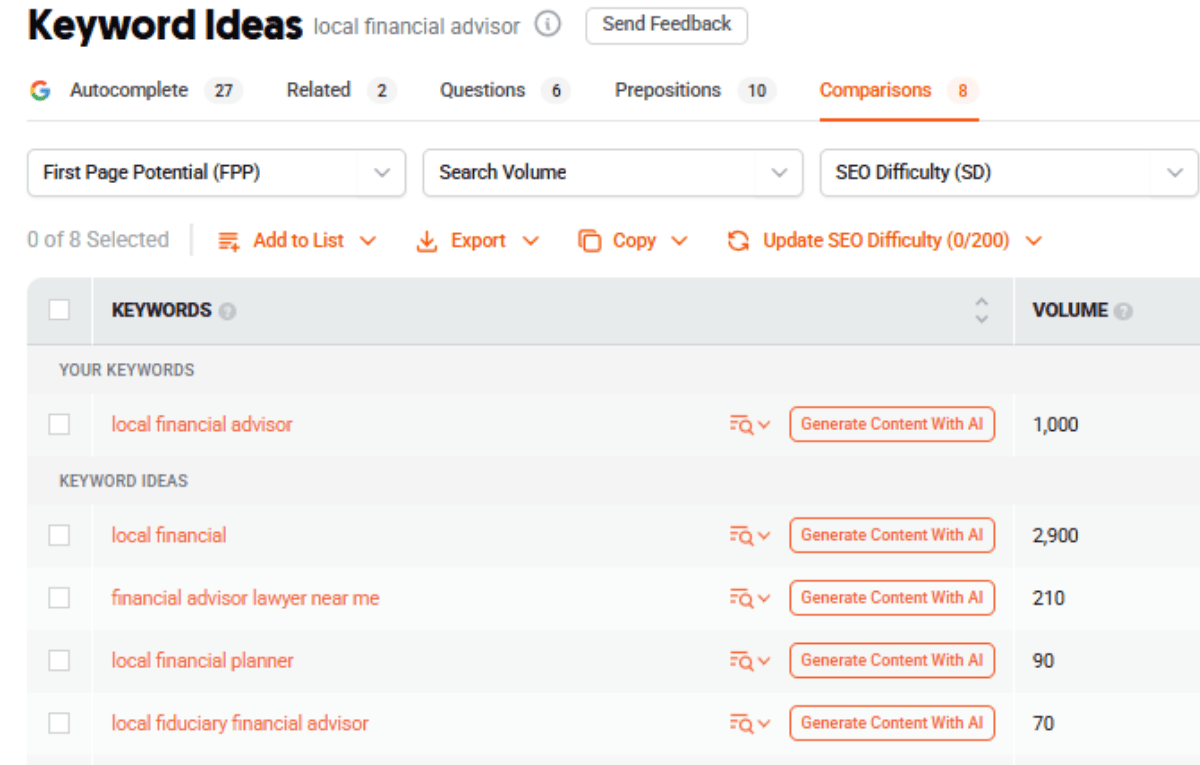
Here’s where the magic starts: keyword research.
You want to target relevant keywords that your prospective clients are actually typing into search engines.
For example, “best financial advisor for retirement planning” or “local financial planner in Florida”. These are called long-tail keywords, and they often convert better than broad terms.
Use the keyword research tools below to search for relevant keywords [source]:
✅ Google Keyword Planner
✅ Ubersuggest
✅ Ahrefs
✅ SEMrush
Don’t forget to look at search volume and keyword difficulty. You want terms with enough traffic, but not so competitive that you’ll never rank.
💡Bonus tip? Spy on what your competitors are ranking for and find gaps in their content strategy.
This stage forms the blueprint of your entire SEO efforts.
Get this wrong, and your content could be targeting the wrong audience entirely.
On-Page Optimization
Time to polish up what’s already on your site. This is called on-page SEO, and it includes things like:
✅ Adding your specific keywords into the page title, meta description, headers (H1, H2s, etc.), and image alt tags
✅ Creating valuable content that speaks directly to your audience’s needs
✅ Linking between your web pages to guide visitors (and search bots) around your site
✅ Using clear formatting, mobile-friendly design, and fast load speeds
Your website content should be built with humans in mind, but structured in a way that search engines can easily understand.
Every page should answer a question or solve a problem for your potential clients.
💡Pro tip: Creating content that is evergreen (always relevant) saves you time and continues to attract traffic over the long term.
Local Search Engine Optimization

Local SEO is your best friend if you serve clients in a specific city or region.
Start by claiming and optimizing your Google Business Profile.
Add business hours, services, a strong description with relevant keywords, and ask happy clients to leave reviews.
Next steps:
✅ Use local search terms like “financial advisor in Orlando” or “wealth management firm in Miami”.
✅ Join local business listings and online directories.
✅ Write blog posts or guides that focus on regional financial news or advice.
Why is this important? Because when someone nearby types “financial advisor near me” into Google, you want to pop up in the local search results, not be buried under ten competitors. [source]
Technical SEO
This part sounds intimidating, but it’s mostly about user experience.
Technical SEO ensures that your website is healthy, crawlable, and speedy.
Google (and your visitors) love:
✅ Mobile-friendly design for mobile devices
✅ Fast-loading pages
✅ Secure websites with SSL (that little padlock in your URL)
✅ Clear navigation and internal links
✅ No broken links or duplicate content
Use Google Search Console to monitor your site’s health and track how well your SEO efforts are paying off.
It also helps you fix any technical issues that might be dragging down your search engine rankings.
Building Your Online Presence

Beyond your website, how visible are you online?
Building a strong online presence means showing up consistently in multiple places.
Here’s how to do it:
✅ Use social media to share valuable insights, blog articles, and industry news.
✅ Join Facebook groups or Reddit forums related to the financial services industry:
✅ Get featured on authoritative websites or contribute guest blog posts.
✅ Connect with other websites through backlinks (Google loves it when trusted sites link to you).
The more connected and active you are online, the more trust and authority you build in the eyes of both Google and your audience.
SEO for Financial Planning

Now, let’s talk specifically about SEO for financial planning.
If your financial advisory practice helps people plan for their future, you’ve got loads of SEO gold to work with.
Think about content like:
✅ “How much should I save for retirement at 40?”
✅ “Investment advice for young professionals”
✅ “Should I get a financial advisor before I get married?”
These are the questions potential clients are asking, and your website should be answering them.
Use specific keywords in your blog titles and page headers, and don’t forget about local SEO here, too.
Someone searching “financial planner in Key West” should find you on the first page of search results.
Creating high-quality content and building quality backlinks will boost your SEO rankings and help your practice attract qualified leads.
Measuring SEO Success
If you’re going to put effort into SEO, you’ll want to know what’s working. This is where tracking comes in.
Use Google Analytics to understand:
✅ Where your visitors are coming from
✅ Which pages they’re viewing
✅ How long they are staying
✅What actions they’re taking (e.g., filling out a contact form)
Pair that with Google Search Console to track:
✅ Which search terms you are showing up for
✅Your keyword rankings
✅Click-through rates from search engine results pages
SEO is a long game, but watching your progress helps you make smarter moves. Adjust your SEO strategy based on what the data tells you.
Avoiding Common SEO Mistakes
It’s easy to trip up when you’re starting out with SEO. Here’s what to avoid:
✅ Keyword stuffing, shoving your target terms into every sentence, is a big no-no.
✅ Using duplicate or thin content
✅ Ignoring mobile optimization
✅ Buying shady backlinks
✅ Skipping your meta description or not using a relevant page title
Stay updated on the latest trends. SEO consultants and blogs (like this one!) can keep you in the loop.
Remember: real, useful content for your audience will always win out over shortcuts.
Summary
Search engine optimization for financial advisors isn’t just a technical add-on. It’s how your financial advisory firm stands out online, attracts more qualified leads, and grows your business sustainably. Whether you’re just getting started or refining your current approach, the right mix of SEO services, content, and tracking can help you increase search engine results and reach the people who need your help.
Feeling Overwhelmed?
If all of the above has got you stressed, don’t panic, ZuluShack Creative is here to save the day. Our SEO services are designed to help financial professionals like you rise above the noise and rank where it counts. Let us take care of the technical stuff so you can focus on what you do best, providing top-tier financial advice.
Frequently Asked Questions
1. How long does it take for SEO to work for financial advisors?
Typically, you’ll start to see results in 3–6 months, but it depends on your industry, competition, and how much content you’re producing. SEO is a long-term game that builds momentum over time.
2. Should I use paid ads instead of SEO?
Paid ads can provide short-term traffic, but SEO for financial advisors offers a more sustainable and cost-effective way to attract potential clients over the long term. Ideally, both should be used in a balanced digital marketing strategy.
3. Is it worth hiring an SEO expert for my financial planning practice?
Yes, especially if you’re too busy to handle SEO yourself. A good SEO agency can build a tailored plan for your financial advisor business, help with keyword research, technical SEO, and monitor your progress.
4. What’s the best content to create for SEO?
Focus on blog posts, guides, and FAQs that answer your clients’ most common questions — especially those related to retirement planning, investment advice, and local search queries.
5. Do I really need local SEO if I offer virtual services?
Absolutely. People still use terms like “financial planner near me” even when searching for virtual advisors. Local SEO helps boost your presence in local search results, which can translate into qualified leads.

Mastering How to Rank in ChatGPT: 7 Essential Strategies for Success
The internet is changing, and so is the way people search. With AI platforms like ChatGPT on the rise, traditional search engines just aren’t cutting it anymore. But don’t stress, we’ve got your back. This guide will show you exactly how to rank in ChatGPT and stay ahead of the competition by using our digital marketing services.
ChatGPT answers questions directly, not with a list of links. However, links to brands are given, which is why today branded search is such a huge ranking factor compared to years ago.
Ranking depends on content relevance, quality, and clarity. Same as with humans.
Writing in natural language helps improve visibility in AI search results. You can see what Google thinks your page is about on its Natural Language API demo.
You need different SEO strategies for AI search engines. Its being called Ask Engine Optimization.
Key Takeaways:
- Understand How ChatGPT Ranks Content
Focus on user intent and write natural, relevant content that directly answers real questions. - Optimize Content with Structured Data
Use schema markup and maintain fast, mobile-friendly pages to help AI understand and surface your content. - Focus on Content Quality and User Needs
Create useful, scannable content with real value that solves problems and keeps users engaged. - Answer Questions the Way ChatGPT Does
Write in a conversational tone with clear formatting and actionable answers, like ChatGPT’s response style. - Use Smart Link Building (Without Spamming)
Earn trust by building branded and topical backlinks through high-quality guest posts and media mentions. - Build Engagement with User-Generated and Interactive Content
Boost dwell time and trust by encouraging user interaction through polls, comments, and community-driven content. - Promote Your Content with SEO and Content Marketing
Blend traditional SEO with AI-specific optimization to stay relevant in both search engines and generative platforms.
What Makes ChatGPT Different from Traditional Search Engines?

ChatGPT is an AI platform that gives direct answers to user queries, no link lists or endless scrolling required. It’s being referred to as a “generative engine” because it generates a response and not a list.
Unlike traditional search engines that throw a bunch of links your way, ChatGPT gets straight to the point. It pulls content from high-quality, relevant sources that AI systems or APIs from other search engines have indexed. [source]
This means ranking on ChatGPT isn’t your typical SEO game, it’s a whole new ballpark.
To rank here, forget about keyword stuffing and focus on creating content that genuinely matches user intent.
You need to be able to craft content that speaks naturally, answers questions directly, and give real value.
Let’s take a look at how you can do this.
1. Understand How ChatGPT Ranks Content
It’s All About User Intent and Relevance
To rank on ChatGPT, you need to think like the AI itself. (Welcome to 2025, where we are trying to think like the machine that’s trying to think like us).
ChatGPT’s mission? Reverse engineer user intent and deliver the most relevant content. Here’s what that means for you:
- Write content using natural language (keep it real).
- Focus on answering the user’s question clearly (no fluff).
- Use structured writing that flows like a conversation (make it easy to follow).
Forget the usual SEO rules. While traditional search engines like Google care about backlinks and page speed, ChatGPT’s all about content quality, relevance, and how well it nails user intent. [source]
So, make sure your content is not just good, but exactly what the user needs.
AI-Driven Answers Are Based on Content, Not Just Links
Unlike traditional search engines, ChatGPT isn’t all about backlinks or domain authority. Nope, it’s got a different set of priorities. Instead, it focuses on:
✅ Relevant material (keep it meaningful)
✅ Up-to-date content (nobody likes outdated info)
✅ Natural language processing signals (speak the language of the AI)
If your content is top-notch and genuinely solves user problems, you’re more likely to see it pop up in those shiny AI-generated responses. So, keep it fresh, keep it relevant, and keep it real.
2. Optimize Content with Structured Data
Add Structured Data and Schema Markup
Even though ChatGPT doesn’t crawl websites like Google does, structured data is still vital when AI platforms pull data from search engine results.
It’s like giving your content a roadmap to help AI systems find and understand it faster.
This is where schema markup comes in. Think of this as a backstage pass for your content. [source]
Schema helps your content get indexed by AI tools, making it easier for them to figure out what your page is all about.
The result? Your content gets seen and understood, making it more likely to show up in those AI-generated answers.
So, don’t skip this step, it’s the secret ingredient for better AI visibility.
Top Tip:
Add schema markup to blog posts, service reviews, and product pages to help AI-driven searches understand the context of your content.
Make Your Site Responsive and Fast
A responsive site with lightning-fast page speed doesn’t just make your users happy, it also gives you a big ol’ thumbs-up from both traditional search engines and AI platforms.
It’s like rolling out the red carpet for both your audience and the algorithms.
The faster and smoother your site runs, the better the chances of ranking higher, whether it’s Google or ChatGPT checking you out.
Speed matters so don’t let your site get stuck in traffic!
3. Focus on Content Quality and User Needs

Create Content That Delivers Real Value
The best way to rank on ChatGPT? Simple, create content that actually helps people.
Whether you’re answering a burning question or offering a solid solution, your content should always be focused on what the user really needs.
Here’s how to make it happen:
✅ Use clear headings and bullet points (nobody has time to read a wall of text).
✅ Write in natural language (keep it real, keep it friendly).
✅ Include multimedia content (images, videos, infographics) to keep things engaging.
If you nail these, you’ll be serving up content that’s not only helpful but totally irresistible to AI and your readers!
Structure for Easy Scanning
Want to take your content to the next level? Add some interactive components like dropdowns or tabs.
Not only will they boost engagement and keep users hooked, but they also make your content a breeze for AI tools to reference in those instant responses.
AI loves content that’s clear and structured, so when your content is organized with interactive features, you’re giving the AI exactly what it needs to pull your info quickly and effectively.
It’s like setting up a VIP lane for your content in the AI world!
4. Answer Questions the Way ChatGPT Does
Mimic the Conversational AI Format
Since ChatGPT loves to deliver answers in a friendly, conversational tone, you should be doing the same.
ChatGPT isn’t here for stiff, formal language, it wants the vibe to be casual and approachable, so your content is more likely to be included in AI-generated answers.
✅ Write clearly and conversationally (no keyword stuffing)
✅ Use concise intros, bullet points, and structured data
✅ Include original data, stats, and case studies
✅ Back everything with strong formatting and schema
Example:
Instead of saying:
“Social media marketing is a digital strategy used by businesses.”
Try:
“Wondering how social media can boost your business? It’s a simple yet powerful strategy used by thousands of brands every day.”
Include Real-Time, Actionable Content
Using real-time data and linking to authoritative sources makes your content more trustworthy.
When AI tools pull data for responses, they’re more likely to go for content that’s fresh, accurate, and credible.
So, if you want to be the go-to for AI-generated answers, keep it relevant and reliable!
5. Use Smart Link Building (Without Spamming)
Guest posting on high-authority sites is a killer way to boost your visibility and rank on ChatGPT.
You’re not just getting your name out there, you’re building credibility with AI platforms too.
Just make sure your posts are packed with relevant content and sprinkle in some brand mentions or links to your own material.
Target anchors: Include any word from your keyword
✅ Branded anchors: Your business/website name
✅ URL anchors: The actual link (naked URL)
✅ Topical anchors: Broader topic of your page
✅ Misc anchors: “Click here,” “this website,” etc.
The more AI sees you as a trusted source, the more likely it is to reference you in those sweet, AI-generated answers.
HARO is dead. Kind of.
We now use HARO, Qwoted, Featured, Help a B2B Writer, and Twitter alerts to get in front of journalists. [source]
Here’s how we build authority in 5 steps:
✅ Pre-written pitch templates tailored by niche
✅ AI + human hybrid to instantly rewrite for each query
✅ 3-sentence quote limit (clear, quotable, credentialed)
✅ Track all wins by author and publication for E-E-A-T
✅ Repurpose quotes into blog content + LinkedIn carousels
Result? Branded links. AI trust. And sometimes even podcast invites.
Instead of trying to compete with DR90 giants, we recommend going deep on one narrow slice of your niche. This gives you the highest chance of being pulled into AI Overviews or chatbot answers, even with a DR 30–40 domain.
Affiliate Sites
Affiliate sites are a goldmine for reaching new audiences, but don’t just throw your name on any random site.
Make sure they’re legit and align with your niche.
The right affiliate partnership can help extend your reach and boost your AI cred, so choose wisely and get your content in front of the right crowd!
6. Build Engagement with User-Generated and Interactive Content
Engagement Metrics Matter
Both AI search engines and traditional search engines keep an eye on how users interact with your content.
If people are sticking around, clicking, commenting, or sharing, it’s a clear signal that your content is hitting the mark and providing real value.
Boost Engagement By:
✅ Adding polls, quizzes, and surveys (who doesn’t love a little interaction?).
✅ Encouraging comments or user mentions (let’s get the conversation going).
✅ Highlighting feedback from niche communities (it’s all about those loyal fans).
User-generated content is like a golden ticket to boosting your brand’s reputation and visibility across AI-driven platforms.
The more engagement you get, the more AI takes notice, so make sure you’re giving your audience a reason to stick around and get involved!
According to Matt Diggity, AI users convert better. “AI-referred sessions average 10.3 minutes compared to 8.1 minutes from Google Search… AI users land on your site already primed with context.” [source]
7. Promote Your Content with SEO and Content Marketing
SEO isn’t dead – it’s just evolving.
To rank on ChatGPT and traditional search engines, you’ve got to mix the best of both worlds.
That means blending tried-and-true SEO strategies with fresh tactics tailored for AI platforms.
Traditional SEO Strategies Include:
✅ On-page optimization, which includes keyword research, content optimization, etc. (yes, they still matter).
✅ Off-page Optimization, which includes link building, social media marketing, and reputation management, etc. (don’t forget the basics).
Modern Tactics Include:
✅ Optimizing for AI search engines (AI is the future, after all).
✅ Ensuring conversational AI understanding (speak the AI language).
Keep Content Up to Date
Content that’s stuck in the past won’t cut it in today’s fast-paced digital world.
Regularly refresh old content with new stats, real-time data, and industry updates.
This keeps AI systems happy and signals that your content is fresh and ready to rank in those AI-generated responses.
Keep it current, keep it relevant, and you’ll stay ahead of the game!
Bonus Tip: Make Your Marketing Strategy ChatGPT-Friendly
To succeed in today’s digital marketing landscape, you’ve got to align your entire strategy with how people actually search.
That means crafting every blog post, service page, and product description with AI-readability in mind.
It’s not just about appealing to the algorithms; it’s about speaking the same language as your audience and the AI platforms that are now doing the searching.
Tips to Make Content ChatGPT-Ready:
✅ Break content into diverse formats like Q&As, how-tos, and checklists (keep it dynamic).
✅ Use conversational language and answer specific user queries (ditch the jargon, keep it friendly).
✅ Provide valuable insights, not filler content (AI knows when you’re fluffing it).
Summary
Ranking in ChatGPT goes beyond traditional SEO, it’s about understanding user intent and creating content that directly answers their needs.
As AI-driven platforms like ChatGPT continue to rise, adapting your content strategy is essential. Focus on natural language, structured data, and valuable insights to boost your visibility.
So, create content that genuinely solves problems and meets user needs, and you’ll be well on your way to ranking on ChatGPT and other AI-driven platforms.
Need help creating content that ranks on ChatGPT and other AI platforms? Our expert team knows exactly how to create content that not only drives results but also gets you noticed. Contact us today and let’s get things ranking!
FAQs: Ranking in ChatGPT and AI Search Engines
1. Which AI engines can you rank on?
You can rank content on several AI engines and generative search platforms — here’s a breakdown of the major players you should be optimizing for right now: ChatGPT (OpenAI + Bing API), Google AI Overviews, Perplexity.ai, You.com.
2. What is the difference between ranking in ChatGPT and traditional search engines?
Traditional search engines like Google and Bing rank based on backlinks and page speed. ChatGPT uses natural language processing and content quality to generate answers, focusing on user intent.
3. How do I make my content more likely to appear in ChatGPT answers?
Write clear, structured content using natural language. Answer specific user queries with relevant, up-to-date information and authoritative sources.
4. Does ChatGPT use SEO signals like backlinks or domain authority?
ChatGPT doesn’t rely on backlinks like traditional search engines. It values relevant, high-quality content that aligns with user intent.
5. Can AI tools like ChatGPT replace traditional SEO strategies?
No, but they change how we approach SEO. Focus on content quality and clarity to rank in both traditional search engines and AI systems.

What is GEO? Understanding Generative Engine Optimization
You’re putting in the work to create some top-notch content, but it’s not getting the visibility it deserves.
Just when you think things couldn’t get more complicated, AI driven search engines show up.
We get it. But this is the future of search engine optimization. This is the future of branding online. This is the future period.
AI-driven search engines are taking over, and your content can’t just check SEO boxes anymore.
It has to connect with how these AI systems understand, rank, and serve your content to users. It’s all about relevance.
That’s where Generative Engine Optimization (GEO) comes in!
Generative Engine Optimization (GEO) helps your content perform better with AI search engines.
It. It’s similar to ranking on traditional search engines, but not exactly the same.
In the blog below, we’ll answer your GEO questions, how it works, and why it’s becoming a game-changer in modern digital marketing.
Key Takeaways
- Relevance Engineering Over Traditional SEO – Brand Marketers should evolve into “relevance engineers,” focusing on:
- Information retrieval: How do AI search engines find your content and is it relevant to the user’s question? Does your website cluster content into categories and sections that are easy to understand, and how easy is it to read?
- NLP Content Strategy: You need to adopt a confident tone, provide citations, highlight relevant statistics, and ensure readability and clarity.
- Digital public relations (PR): Where can AI engines find your brand being mentioned?
- Structured Data as a Secret Weapon – Embedding key content within structured data formats, such as Schema.org, gives AI search engines the ability to extract and utilize information effectively.
- Embracing Generative Engine Optimization (GEO) – GEO involves tailoring content to be more accessible and valuable to LLMs by:
- Adopting an authoritative tone and providing citations
- Highlighting relevant statistics
- Ensuring readability and clarity
- Influencing Retrieval-Augmented Generation (RAG) Systems – RAG systems can be guided through “semantic trickle” by phrasing content in straightforward subject–predicate–object formats, making it easier for AI to extract meaningful information.
What is Generative Engine Optimization (GEO)?

Generative Engine Optimization (GEO) is about tailoring your content and website specifically for AI-driven search engines. Engines like Google AI Overviews, ChatGPT, and Perplexity.
At its core, GEO helps your content reach more people on more platforms so that more users come to your website. More traffic, more trust, more conversions.
GEO ensures your website isn’t just discoverable, but also well-represented by AI-powered engines that are shaping the future of search.
Recommended Tools and Tactics
- ZipTie: Tracks AI overview visibility across queries
- Profound: Monitors generative search presence
- CrUX + Core Web Vitals: Ensures pages are fast and indexable
- Schema.org: Implements rich structured data
- Google DOJ Documents: Provides insights into Google’s values and priorities
More and more people are using AI-driven search engines, which means that businesses must adapt their digital marketing strategies to include GEO. It’s not just the latest trend, it’s the future of search. Unlike traditional search engines, AI engines focus on contextual relevance.
Traditional search engines are changing… heck they’ve changed a lot in the past 12 months already. But they aren’t slowing down.
Unique Aspects of Generative Engine Optimization

✅ Built for AI comprehension:
Generative Engine Optimization (GEO) uses natural language processing (NLP) to structure content in a way that’s easy for AI to understand, summarize, and present.
✅ Goes beyond keywords & backlinks:
GEO prioritizes relevance, clarity, and trustworthiness over keyword density. You have to prove that you can be trusted through content quality, citations, statistics, sources, authorship, and real Subject Matter Expert insights.
✅ Optimizes for synthesis, not just rankings:
Rather than optimizing solely for SERP position, GEO ensures your content is the kind that AI systems pull into their AI generated responses.
✅ Blends SEO + GEO for maximum reach:
The best strategies combine traditional SEO techniques like keyword research with GEO’s adaptability, ensuring your message gets seen, clicked, and trusted by both people and AI.
As AI-generated search continues to rise, GEO helps ensure your content remains competitive, discoverable, and aligned with evolving user behavior. And hey, that’s exactly what we want.
GEO In The Wake Of The Search Engine Volume Drop
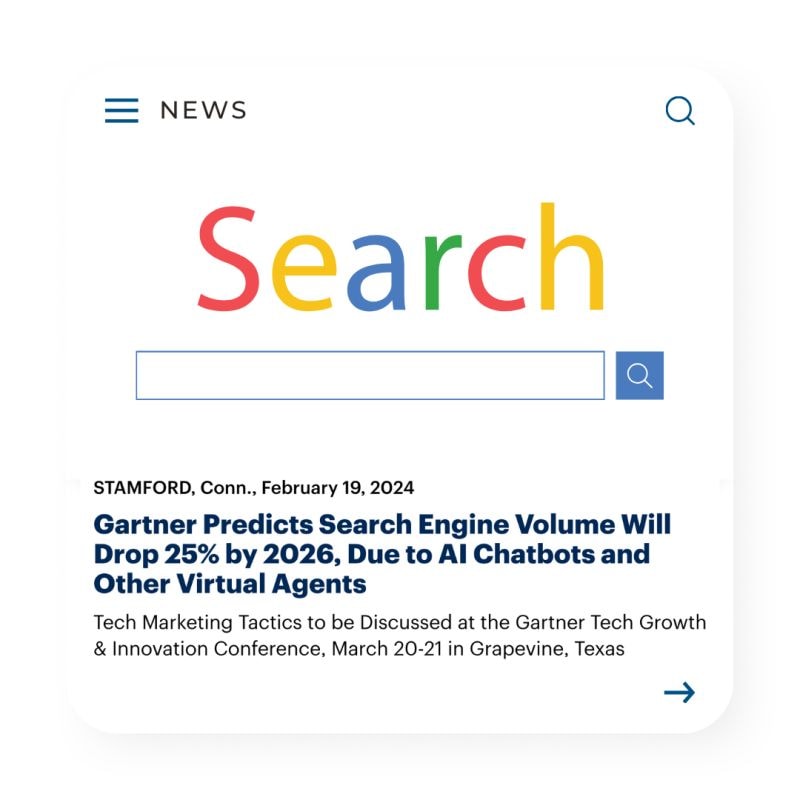
Gartner predicts that search engine volume will drop by 25% by 2026. All thanks to AI chatbots and other virtual agents.
As users are flocking to platforms like ChatGPT, Perplexity, and Google AI Overviews for direct and comprehensive responses. So what? Well that means your content needs to be optimized not just for humans, but for how machines read, retrieve, and respond.
✅ GEO ensures your brand remains visible and trusted in an AI-first world.
✅ It helps your content become the source AI models quote, summarize, and surface.
✅ And it builds a stronger, smarter brand presence, wherever your audience asks questions.
💡 Leading digital marketing agencies are already shifting strategies, building content with GEO principles to thrive in this new search landscape.
If you want your content to shine where search is heading, GEO is the strategy to bet on.
The Natural Evolution of GEO
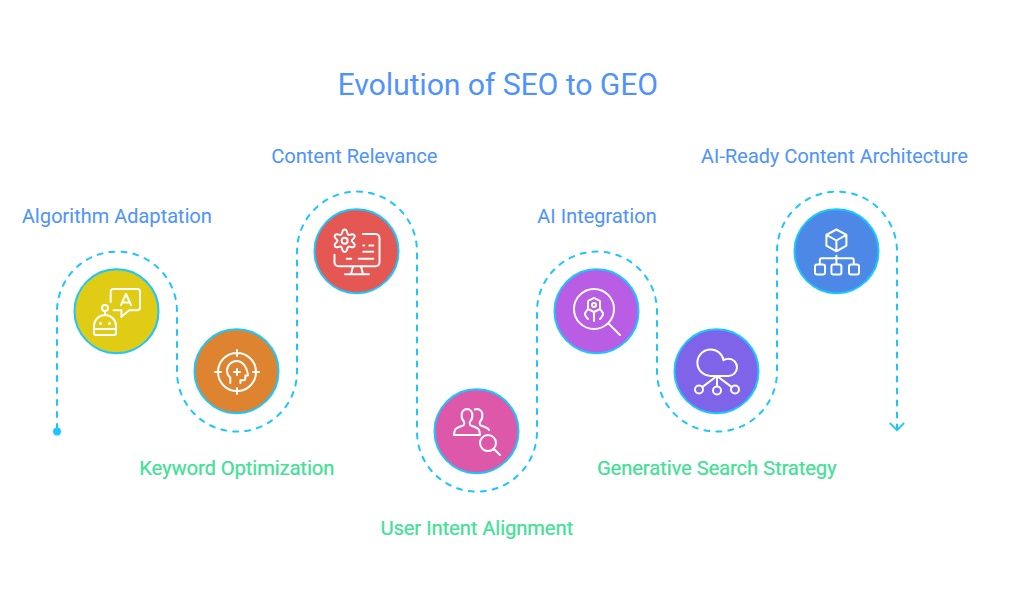
1. From Keywords to Concepts
- SEO focused on matching keywords to user queries.
- GEO focuses on matching concepts and context to AI model outputs.
Instead of asking, “What keyword do I want to rank for?” GEO asks, “What’s the best way to teach an AI to use my content as the answer?”
2. From Pages to Passages
- SEO traditionally optimized whole pages.
- GEO methods optimize semantic chunks (passages of 50–150 words) so that large language models (LLMs) can easily extract information.
Think: clear headings, concise answers, and logical flow. Every paragraph matters.
3. From SERPs to AI Overviews
- SEO lived and died on blue links in the Search Engine Results Page (SERP).
- GEO competes for inclusion in AI Overviews and generative answer engines like:
- Google SGE
- ChatGPT
- Perplexity
- Bing Copilot
In GEO, your content isn’t just trying to rank, it’s actually trying to be quoted or cited in AI’s response. That’s a whole different ball game.
4. From Optimization to Relevance Engineering
- SEO was about relevant keywords, structure, tags, and links.
- GEO is about training LLMs to recognize your content as trustworthy, structured, and useful.
This includes:
- Structured data (schema)
- Subject-matter expertise
- Cited sources
- Conversational tone with depth
So, What Do You Do Differently With GEO?
- Create AI-friendly content that uses clear subheadings, concise answers, and structured formats.
- Use E-E-A-T principles aggressively (Experience, Expertise, Authoritativeness, Trust).
- Focus on brand search volume and entity recognition.
- Monitor your presence in AI tools, not just in Google SERPs.
- Publish content that AI models want to reference, not just humans.
GEO vs. Traditional SEO: Key Differences
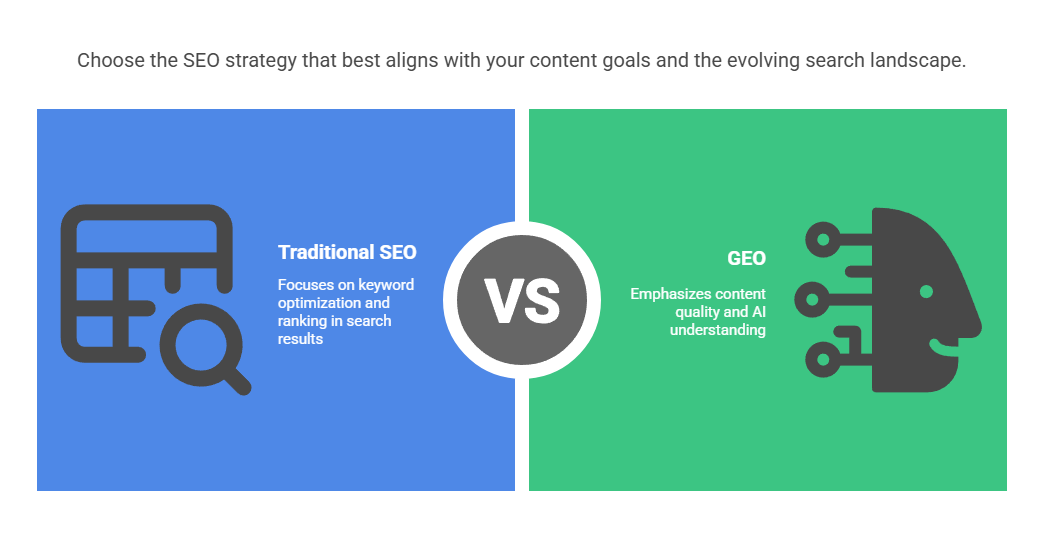
GEO ensures your content is picked up and used by AI-driven tools, not just trying to rank higher in traditional search results. [source]
The focus is on optimizing content for AI-driven search engines like Google AI Overviews, ChatGPT, and Perplexity. You wouldn’t do the same things to boost your rankings as you would with traditional SEO, but they are quite similar.
It emphasizes the quality of your content and how it’s structured. It’s less about playing to the AI algorithms and traditional search engine formats and more about making your content easy for AI to understand and use.
GEO is designed for the new wave of AI-powered searches that don’t just list links – they pull together information from multiple sources and deliver it to intended audiences effectively as AI generated results.
Traditional SEO practices focus on optimization strategies like keyword placement.
GEO vs. Traditional SEO: Key Similarities
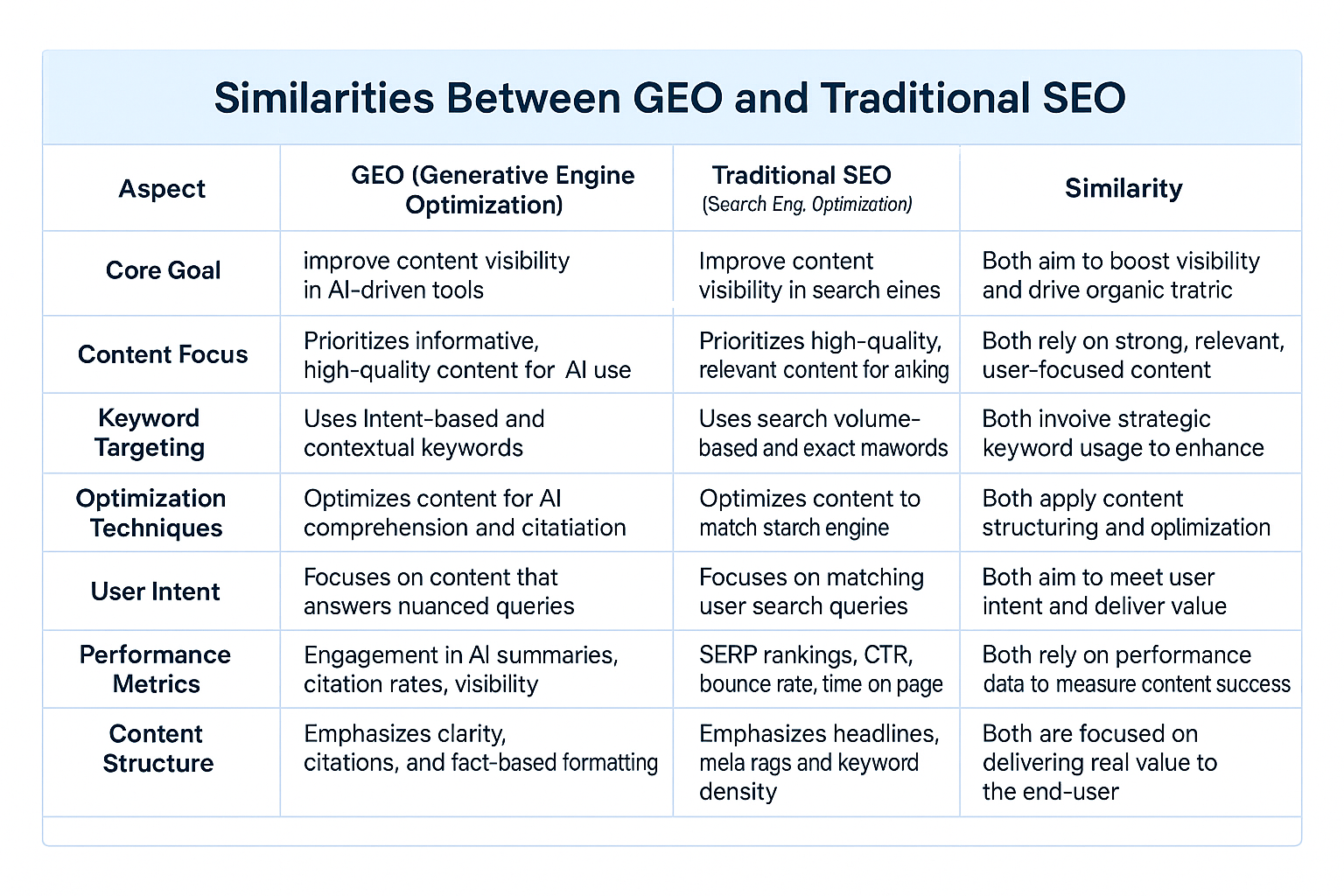
Both SEO and GEO are focused on the same big goals: getting your content seen and engaging your audience.
Both approaches rely heavily on unique, relevant content because quality matters.
And that’s the case whether you’re optimizing for AI tools or traditional search engines. It’s all about creating content that meets user expectations and delivers real value. It’s as simple and as difficult as that.
Both also use similar techniques, like keyword targeting and content creation optimization, to improve search rankings.
Traditional SEO tracks keyword performance, is more focused on search volumes and impressing search engine algorithms. On the other hand GEO focuses on helping AI-driven tools understand and use your content effectively.
So, whether you’re going the SEO route or diving into GEO, you’re ultimately working toward the same thing: boosting your website’s visibility and driving more organic traffic.
How Generative AI Engines Work

- Massive Data Training – Generative AI models like ChatGPT and Gemini are trained on vast datasets, powering AI-powered search engines with data from books, articles, and websites.
- Pattern & Context Recognition – AI learns language patterns, improving organic search metrics by providing natural, relevant responses based on context.
- Multi-Source Input – These search technologies pull information from diverse sources and structured data, boosting organic search traffic by delivering accurate and comprehensive responses.
- Powered by Large Language Models (LLMs) – LLMs use machine learning techniques like transformers, helping AI-powered search engines generate relevant, high-quality content.
- Contextual Understanding – AI understands word relationships in context, enhancing organic search metrics by providing human-like comprehensive answers.
- Input Encoding & Output Decoding – User input is processed into structured data, improving SEO and organic search traffic expected through optimized content generation.
- Intelligent Synthesis – AI synthesizes information across multiple sources, creating concise, relevant content that drives other organic search metrics.
- User Intent Matching – AI aligns responses with user behavior and search intent, essential for GEO strategies and improving organic search metrics.
- Search Behavior Influence – As AI understands user needs better, it reshapes organic search and content visibility, boosting search traffic.
- Human-Centric Output – The goal is to generate human-centric content that aligns with user expectations, improving organic search metrics and engagement.
Measuring GEO Performance

To gauge how well your content is performing in AI-driven search results, focus on these indicators:
- Visibility in AI Responses – Monitor how often your content appears in AI-generated answers.
- User Engagement Post-Referral – Assess how users interact with your site after arriving via AI platforms.
- Brand Authority Perception – Evaluate how AI-driven platforms perceive your brand’s authority.
- Utilizing UTM Parameters for AI Traffic – Implementing UTM parameters helps track the source of your AI referral traffic.
- Establishing Benchmarks and Continuous Monitoring – Set initial benchmarks for these metrics and regularly compare them against industry standards.
Future Of Generative Engine Optimization
As AI-driven search engines evolve, search engine optimization tactics like keyword stuffing are becoming less effective. The rise of generative AI has led to a significant shift in how content is created and consumed. According to McKinsey, 65% of organizations now regularly use generative AI, nearly double the adoption rate from the previous year.
The future of GEO lies in continuous adaptation and innovation. By embracing the capabilities of generative AI and aligning content strategies with the evolving landscape, businesses can ensure their content remains visible, relevant, and impactful in AI-driven search results.
As AI and answer engines continue to dominate search engine results pages (SERPs), integrating GEO strategies into your digital marketing strategy is important for staying competitive in an increasingly AI-powered world.
Frequently Asked Questions
How does GEO differ from traditional SEO?
GEO differs from traditional SEO by focusing on content quality and structure for AI platforms, aiming to meet user intent and create better conversational experiences, not just target keywords.
Why is GEO important in modern search?
GEO helps AI platforms deliver more relevant, personalized results by considering location, context, and user intent, ensuring accurate, timely responses.
What are some key strategies for optimizing content for GEO?
To optimize for GEO, use structured data, authoritative content, and language that aligns with AI models, boosting visibility, engagement, and relevance to user intent.
How can I measure the performance of my GEO efforts?
Track GEO performance by monitoring AI visibility, post-referral engagement, brand mentions, and UTM-tagged traffic, ensuring your content meets user intent via AI and answer engines.

5 Strategies to Improve Your Google Rating in 2024

In the vast landscape of the internet, where billions of websites compete for attention, mastering the art of Google ranking is essential for standing out. Google is not able to judge content the way you and I do; it’s a meticulously designed algorithm fueled by code and mathematics. Understanding how this digital behemoth operates is the first step towards optimizing your content and climbing the search result ladder. So, it’s time to dive into the actions and strategies that will help you with your search engine optimization in 2024. Buckle up!
For additional information on services or advice relating to Search Engine Optimization (SEO), web development, and app building, be sure to check out Zulu Shack’s main site!
Key Takeaways:
- Google’s assessment of content quality encompasses various aspects, including relevance, authority, user experience, engagement metrics, freshness, structured data usage, and accessibility standards adherence.
- Google utilizes metrics like bounce rate and time spent on page to gauge user satisfaction with content. While these metrics are important, they’re not always definitive indicators, and Google’s algorithms consider multiple signals for accurate judgments.
- To enhance content visibility on Google and ultimately increase your Google ranking, focus on user intent, incorporate key takeaways for quick understanding, optimize readability, include clear calls-to-action, prioritize site speed, and utilize relevant keywords in titles and descriptions.
How Does Google Determine Quality Of Content?

Google’s primary mission is to cater to the needs of its users. Every tweak to its algorithm aims to enhance the search experience by delivering the most relevant and valuable content. Consequently, to boost your Google ranking, you must align your content with the user-centric criteria that Google values.
Naturally, this leads us to the question: what user-centric criteria and algorithms does Google use exactly? Google uses a variety of algorithms and methods to determine if the content on the web is high quality. While the exact details of these algorithms are proprietary and not disclosed by this search engine, they generally aim to assess the relevance, authority, and user satisfaction of content. Here are some factors that Google considers:
- User Interaction
- Website Authority
- Goal Delivery
- Informational Queries
- Quick Calls-to-Action
- Click-Through Rates
Google’s ranking methodology centers around analyzing user interaction to assess content relevance and usefulness. Crafting resonant content that promptly fulfills audience needs is vital. To ascend in Google’s ranking hierarchy, your content must also prioritize goal completion. You can entice users with intriguing titles and concise descriptions, which will increase the likelihood of clicks and enhance your visibility on Google.
Whether it’s answering a query, providing information, or offering a solution, clarity and conciseness are paramount. Google also considers user experience factors like page loading speed, mobile-friendliness, and ease of navigation, while avoiding intrusive ads. These elements contribute to a website’s authority, along with backlinks from reputable sources.
To enhance your site’s ranking, prioritize accurate, comprehensive, and original content. By strategically placing quick call-to-actions (CTAs) throughout your content, you can streamline the user journey and encourage goal completion. Furthermore, prioritize optimizing site speed. A seamless and responsive browsing experience not only enhances user satisfaction and increases click-through rates but also positively influences your Google ranking.
In the intricate ecosystem of Google ranking, mastering the nuances of user interaction and optimization techniques is essential for success. By prioritizing user satisfaction, delivering valuable content, and optimizing for engagement, you can elevate your Google ranking and establish a formidable online presence. The key to success: Embrace the algorithms, understand the metrics!
If you’re new to SEO, I’d highly recommend reading the following blog where you can delve deeper into link-building, backlinks, and some of the other terms discussed in this blog.
What Does Google Consider Bad-Quality Content?
Now that we understand what Google considers high-quality content, it’s time to ask the latter: What does Google consider bad-quality content? In other words, we need to understand what Google deems as bad-quality content to ensure we avoid potential pitfalls that could harm our website’s ranking. Examples of the following include:
- Thin Content
- Keyword Stuffing
- Duplicate Content
- Spammy Links
Thin content, which lacks substance and offers little value to users, does not contribute to goal completion by any means–it actually does the opposite. More so, keyword stuffing, another frowned-upon practice, involves overloading content with keywords to manipulate search engine rankings. Lastly, replicating content from other sources without adding value and including links to unrelated or spammy websites solely for ranking purposes, or presenting different content to search engines than what users see are all frowned upon. To maintain a positive reputation with Google and improve your website’s ranking, it’s essential to focus on creating high-quality, user-centric content that prioritizes relevance, value, and authenticity while adhering to Google’s quality guidelines.
If you’re new to SEO, I’d highly recommend reading the following blog where you can delve deeper into key terms discussed in this blog, as well as learn the proper etiquette and unspoken rules of SEO.
5 Actionable Steps to Improve Your Google Ranking:

Now that we’ve established a basis of understanding, a series of do’s and don’ts, we can finally delve into the five actionable steps that you can take today to enhance your site’s Google ranking and establish a strong online presence. From optimizing on-page elements to creating high-quality content and building authoritative backlinks, these strategies will empower you to elevate your site’s SEO performance and achieve lasting success in the competitive digital world.
(1) Optimize On-Page SEO: Enhance your website’s visibility in search results by optimizing on-page elements such as titles, meta descriptions, headers, and URL structures. Incorporate relevant keywords naturally throughout your content and ensure it is well-structured and easy to navigate. Additionally, optimize images with descriptive alt tags to improve accessibility and keyword relevance. To learn more about creating a professional and successful website, make sure to read our blog on web design!
(2) Create High-Quality Content: This step cannot be emphasized enough! Creating high-quality content is the number one way to improve your SEO and online presence. Produce engaging, informative, and valuable content that addresses the needs and interests of your target audience. Focus on providing solutions, answering questions, and offering unique insights to establish your site as a reputable source of information. Regularly update your content to keep it fresh and relevant, and aim for a good balance of text, images, and multimedia elements to enhance user engagement. For more tips on outlining and creating quality content, be sure to check out this article here!
(3) Build Quality Backlinks: Earn backlinks from authoritative and relevant websites within your industry or niche to improve your site’s credibility and authority in the eyes of Google. Focus on obtaining natural and organic backlinks through guest blogging, outreach campaigns, and networking with influencers. Avoid low-quality or spammy backlinks, as they can have a negative impact on your ranking.
(4) Improve Website Speed and Performance: Enhance user experience and reduce bounce rates by optimizing your website’s speed and performance. Compress images, minify CSS and JavaScript files, enable browser caching, and utilize content delivery networks (CDNs) to speed up page loading times. Mobile optimization is also crucial, as Google prioritizes mobile-friendly websites in its ranking algorithm.
(5) Monitor and Analyze Performance: Regularly track your site’s performance using tools like Google Analytics and Google Search Console to identify areas for improvement and track progress over time. Monitor key metrics such as organic traffic, bounce rate, average session duration, and keyword rankings to gauge the effectiveness of your SEO efforts. Use this data to refine your strategy, address any issues, and capitalize on opportunities to further enhance your site’s Google ranking.
By implementing these actionable steps consistently and strategically, you can improve your site’s visibility, attract more organic traffic, and ultimately boost your Google ranking. Remember that SEO is an ongoing process, and staying informed about algorithm updates and industry trends is essential for long-term success.
Full Summary:
Mastering the intricacies of content quality evaluation by Google is paramount for any website aiming to excel in today’s digital landscape. By grasping the multifaceted factors that contribute to content assessment, from relevance and authority to user experience and engagement metrics, websites can refine their strategies to meet Google’s standards effectively. Moreover, recognizing and avoiding practices that lead to low-quality content is essential for maintaining credibility and relevance in the eyes of both users and search engines. With a clear understanding of these SEO practices and a commitment to delivering valuable, user-centric content, websites can position themselves for sustained success and increased visibility in Google’s search results.
You too can succeed in achieving a high Google ranking by implementing these proven strategies and guidelines. By focusing on delivering valuable, user-centric content and adhering to SEO best practices, you can enhance your website’s visibility and attract more organic traffic. With dedication and perseverance, you can elevate your online presence and reach a wider audience, ultimately driving growth and success for your website or business.
Frequently Asked Questions
Is it true that Google penalizes websites for excessive monetization or pushy calls to action?
Contrary to common belief, Google doesn’t necessarily penalize websites for monetization efforts or assertive calls to action. Many e-commerce websites rank highly in SERPs despite employing such tactics. However, balancing monetization with providing valuable content and a positive user experience is essential.
How important is user intent in Google’s ranking criteria?
User intent plays a crucial role in determining content quality from Google’s perspective. Content that effectively satisfies user queries and provides valuable information aligned with user intent is more likely to rank well. Therefore, understanding and addressing user intent is essential for SEO success in 2024.
What are the key factors Google considers when determining content quality?
Google evaluates content based on relevance to the search query, authority of the website or page, user experience factors like page loading speed and mobile-friendliness, content quality including accuracy and originality, engagement metrics such as click-through rate and time spent on page, freshness for timely topics, structured data usage, and accessibility standards adherence.
How does Google identify bad-quality content?
Google assesses user satisfaction by analyzing interaction metrics like bounce rate and time spent on page. If users quickly return to the search results after visiting a page, it may signal dissatisfaction. However, this isn’t always definitive, as some users might find what they need quickly and exit, so Google’s algorithms consider various signals to make judgments.
What strategies can I use to improve my content’s ranking on Google in 2024?
To enhance content visibility on Google, focus on goal completion, incorporate key takeaways for quick understanding, optimize readability with font styling, include clear call-to-actions, not overly worry about bounce rate, avoid clickbait titles, prioritize site speed, organize content with a table of contents, and utilize relevant keywords in titles and descriptions.

The Top 7 SEO Tools Every Local Business Needs in 2024
In certain professions, relying solely on your individual resourcefulness, physical prowess, or drive may suffice; however, search engine optimization(SEO) and digital marketing do not fall into that category. In this industry, success often hinges on a combination of strategic thinking, technical skills, and adaptability, making it essential to leverage specialized tools and resources. At this point you may be asking yourself: As a local business owner, how will I be able to achieve my online marketing goals without the experience and technical knowledge of professionals? Great question! Well, out of the dozens and dozens of options out there, I’ve devised a list of user-friendly and helpful SEO tools that I think are the best for helping local businesses achieve their online marketing goals.
What is an SEO Tool?
To start, let’s make sure we understand what SEO tools actually are. An SEO tool can be defined as a software or online platform designed to improve some aspect of search engine optimization, such as online visibility and ranking on search engines like Google. Widely used by online marketers and SEO professionals, SEO tools offer a range of features that serve various purposes, such as search query analytics, reporting automation, content optimization, website performance analysis or audits, and so much more.
What Makes a Good SEO tool?
As a local business owner, your time and resources are finite. Thus, it is clear that you are in need of an easy and effective SEO tool, but what exact characteristics make an SEO tool “good” or useful? What makes a “good” SEO tool for your business may differ from what would be considered a “good” SEO tool for professional SEO marketers, let’s say; however, there are some basic parameters we can use to determine the value of SEO tools. If you are unsure if a SEO tool is right for your business needs, ask yourself if the following characteristics are existent: (1) SEO-centric functionality, (2) value, (3), user-friendly, (4) integrated platforms. Now, what does this all mean? SEO-centric functionality means that every SEO tool should have an element that relates back to search engine optimization. This is step one–if your SEO tool of choice does not actually relate to any elements of SEO (i.e. keyword analysis, audit tools, on-page performance assessment, competitor analysis, etc.), you should probably look for another option. Secondly, if your SEO tool of choice requires a subscription, does the price equate to the quality of the product and its services? In this blog, I will offer some SEO tools that are free; however, the majority are not, so it is important to be able to properly gauge if the tools offered are extensive and comprehensive enough to warrant the subscription price. Although it ranks third on the list, this characteristic holds significant importance nonetheless. User experience and friendliness should be of your top considerations for SEO tools. Keep in mind that there will be a learning curve with all of the below noted SEO tools–as there is for everyone, SEO professionals and local business owners alike–but that learning curve should be relatively low so users are able to access features they need, as well as seamlessly integrate these tools into their performance1. Lastly, a key characteristic of a good and useful SEO tool is its ability to be integrated into other software products. To further elaborate, users should be able to integrate the offered SEO tools and features into their common-place business platforms that already exist, such as platforms relating to tasks like meetings, reporting, scheduling, and customer management.
The Top 7 SEO Tools for Local Businesses in 2024:
The following list was curated with the local business in mind. The listed SEO tools have been chosen because they are user-friendly and easy to navigate, with a minimal learning curve and no technical skills required. Also, keep in mind that in order to see meaningful progress via these SEO tools, there should be continuous effort put forth and monitoring in place to ensure long-term improvement in your business’s SEO2. Remember, a SEO tool is only as great as the effort you invest in utilizing it effectively. With that being said, let’s take a look at my top ranking SEO tools for local businesses in 2024:
- Google Search Console
Coming in first place is Google Search Console (GSC), previously known as Google Webmaster Tool. GSC is a free web service that allows for improved SEO, so while it does not technically fall under the definition of SEO tools, this Google service is excellent for optimizing your website’s visibility and traffic flow. This service will allow you to understand how Google is interacting with your site, which if you are at all familiar with SEO, you know that Google’s interaction and ranking of your website is key to successful SEO. Features of this free web service allows you to receive alerts about indexing and spam issues, check search queries, identify page errors or broken links, and overall optimize the visibility of your website. While Google Search Console lacks some of the more robust and advanced features of other SEO tools, it acts as a great starting point and introductory for local businesses trying to improve their SEO.
- Google Ads Keyword Planner
While this tool is also not technically considered an SEO tool, its utilization and application directly impact one’s search engine optimization performance. A big aspect of SEO is keyword research, which can be defined as the process of identifying and analyzing the words and phrases that people use when searching for information, products, or services on search engines like Google. To simplify, if your site keywords are not specified to that of your target audience, your site will not appear in the search results when users are searching for your specific good or service, which results in minimal to no site traffic. Enter, Google Ads Keyword Planner. This free web service is so easy to use! You simply plug your site URL into the search engine and Google will present you with tons of suggested keywords based on your URL. You can then begin to integrate some of those keywords into your site–it’s as simple as that!
- Google Analytics
How shocking! Another free Google web service to improve your SEO. You will quickly learn that Google will become your best friend when it comes to search engine optimization. Just as much as you want your website to succeed and have high online visibility, Google wants to provide users with sites like yours to meet user needs–your needs are mutually exclusive. This Google web service is for the local business owner who is a bit more tech-savvy. Google Analytics uses crawling bots and analytics to track website performance with the end goal of improving online marketing. Such a tool will help identify and organize sources of user traffic, gauge the success of marketing activities and content, as well as discover patterns within your user engagement. All of this information can be applied and leveraged to improve your local business’s SEO.
- Ahrefs
Ahrefs is an online platform that boasts many free SEO tools and resources. This SEO tool has quickly become one of the most popular tools on the market since their release in 2011. One of the features I love about Ahrefs is that it offers both free and paid SEO tools and resources. This allows you to first get comfortable and acquainted with the platform, as well as see its capabilities and effectiveness before dropping x amount of money on a subscription that you are completely unfamiliar with. I would also agree that the paid version of Ahrefs does fairly equate to the services and features you would be receiving. Another noteworthy quality of Ahrefs’ is that it is considered to be an all-in-one SEO tool, which means the platform offers an array of features, including but not limited to competitor analysis, site audits, content discovery, keyword research, and more. Furthermore, if you do opt for a paid subscription to Ahrefs, they offer user-support to help guide you through any confusion with the platform. Lastly, Ahrefs also provides free educational resources and classes, with live customer support if needed. All in all, Ahrefs is a wonderful SEO tool for local businesses that proves to be extremely user-friendly and effective.
- SemRush
SemRush is another fantastic SEO tool used and trusted by both professionals and local businesses. While this SEO tool can be on the pricier side, the features and services provided make it well worth the price. The platform offers an extremely comprehensive and extensive toolkit to address all of your SEO and local SEO needs. This SEO toolkit covers everything from keyword research and content to technical analysis and backlink analytics. I might add that SemRush is also highly organized and boasts various features that allow you to continually track and edit your projects. This platform offers a structured and straightforward approach to search engine optimization that makes it a great option for local businesses.
- Screaming Frog
Screaming Frog is considered to be an SEO spider tool, meaning this platform utilizes a software that “crawls” around on a website to harvest and present data to the user. Screaming Frog can be an extremely useful tool for local businesses as this platform does not require you to have a deep or extensive knowledge of SEO in order to identify issues and their solutions–Screaming Frog will do it for you! Whether it’s addressing something as seemingly small as title tags or tackling more complex issues, Screaming Frog will filter these issues for you. Another great feature of Screaming Frog is that it boasts both free and paid features, so if you are at all hesitant about pressing send on your SEO journey, you can start for free at no loss. In addition, the paid version is set at a yearly price that I would consider as fair given the platform’s services and features.
- Surfer AI
If you are looking for a well-rounded SEO tool, this may not be the choice for you; however, if you are specifically looking to improve the quality and ranking of your content, this is just the tool for you! Surfer AI is a great option for local businesses who lack attractive and high-ranking content. Whether you are not an experienced writer or simply lack the time, Surfer AI will facilitate the research, writing, and optimization process of content creation for you! Content is one of the most important aspects of successful SEO, so while this SEO tool comes at a price, its features and their results are 100% worth it.
A Few Parting Tips to Keep in Mind:
I know that often people have this perception of digital marketing that it has to be extremely technical and complicated, involving a lot of coding and tech. While this can be true in some cases, there are many aspects of search engine optimization that are relatively straightforward and do not require much time. Thus, my point is do not measure the effectiveness or worthiness of a tool based on the time and knowledge required. Something as seemingly small as a title tag, as noted previously, has huge impacts on your search engine optimization! To add to that point, you do not need to have a SEO tool that will present you with one-hundred different tasks. While those types of SEO tools are out there and serve their own purpose, your search engine optimization can be greatly improved by just a few tweaks here and there. In this case, less is more. You by no means need to have the fanciest or most expensive SEO tool to start improving your search engine optimization, so do not let perceptions or lack of knowledge stop you from improving your local business’s SEO today!