
Search is changing fast.
And if you’ve Googled anything recently, you’ve probably noticed it already. Instead of just showing a list of websites, Google is increasingly answering questions directly using AI-generated summaries, recommendations, and interactive search experiences.
At Google I/O this month, Google confirmed what the SEO industry has suspected for a while now:
The traditional “10 blue links” version of Google Search is on its way out.
Search is becoming more conversational, more interactive, and a lot more AI-driven.
That naturally raises the question:
How do businesses make sure they still show up?
Fortunately, Google has finally shared official guidance on what websites should be doing to improve visibility in AI-powered search experiences like AI Overviews and AI Mode.
The good news?
A lot of it comes back to SEO fundamentals.
The better news?
This is exactly the kind of work we already do at Zulu Shack Creative.
Is SEO Still Relevant?
Short answer: SEO is AEO is GEO… so absolutely yes.
Google made it very clear that its AI search features still rely heavily on traditional search systems.
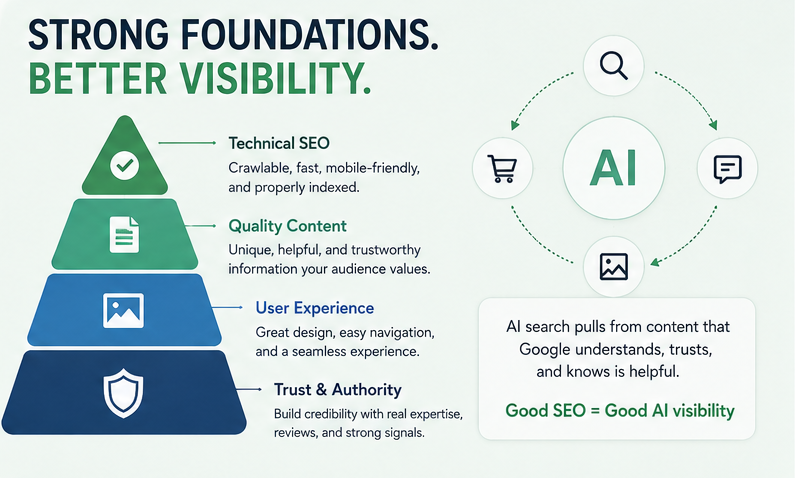
AI doesn’t magically “know” everything. It still pulls information from websites Google trusts and understands.
That means your website still needs:
- Good content
- Clear structure
- Strong technical SEO
- Helpful information
- Trust signals
In other words, good SEO = better visibility in AI search.
The industry has started using terms like “AEO” (Answer Engine Optimization) and “GEO” (Generative Engine Optimization), but Google’s stance is this:
“Optimizing for AI search is still SEO.”
What Google Says Actually Matters
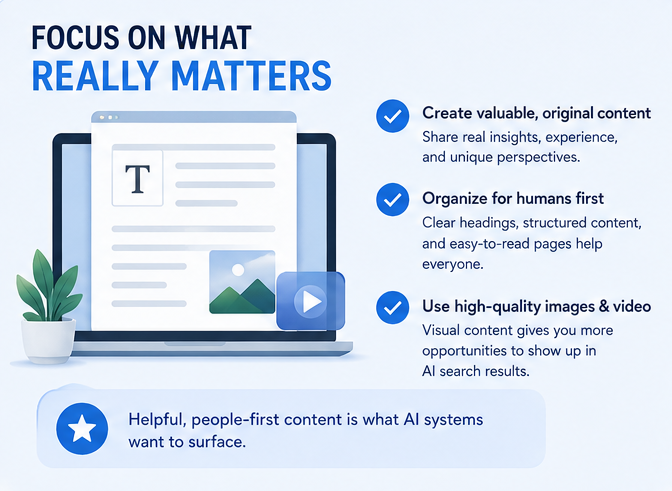
Here are the biggest takeaways from Google’s new recommendations:
1. Create genuinely useful content
Google repeatedly emphasized that AI systems prefer content with:
- Genuine expertise
- Original insights
- First-hand experience
- Unique perspectives
They specifically warned against generic, copy-paste content that says the same thing as every other website.
So instead of creating another generic article like:
“7 Tips for Buying a Home”
Google would rather prioritize something more specific and experience-driven, like:
“Why We Skipped the Home Inspection and What Happened Next”
The reason for this is that AI systems are trying to surface content that actually adds value, and “ignores” content that is created just to rank.
2. Stop trying to “game” AI search
This was one of the more interesting parts of Google’s announcement. There’s been a lot of online noise around “AI SEO hacks” lately.
Things like:
- Creating special AI files
- Overusing keywords
- Breaking content into tiny chunks
- Writing specifically for AI bots
- Chasing fake online mentions
However, Google basically said that your website doesn’t need to do any of that. In fact, many of those tactics are ineffective long-term.
Instead, Google says websites should focus on:
- Being genuinely useful
- Structuring content clearly
- Maintaining good technical SEO
- Providing a good user experience
3. Technical SEO still matters (a lot)
AI can only use content it can properly access and understand.
Google emphasized that websites still need:
- Proper indexing
- Crawlable pages
- Mobile-friendly design
- Fast load speeds
- Clear site structure
- Reduced duplicate content
This is the less glamorous side of SEO, but it’s incredibly important. You can have amazing content, but if Google struggles to crawl or interpret your site properly, your visibility will suffer.
4. Images and videos are more important than ever
Google also highlighted that AI-powered search experiences are increasingly pulling in:
- Images
- Videos
- Visual explanations
- Interactive content
That means websites using high-quality visuals may have more opportunities to appear in AI-driven results beyond just traditional links.
The Big Shift Nobody Can Ignore
This wasn’t just a small SEO update. Google is fundamentally changing how search works.
Search queries are becoming:
- Longer
- More conversational
- More personalized
- More action-oriented
Google is also introducing AI “agents” that can:
- Monitor the web for users
- Gather information automatically
- Track products, prices, trends, or opportunities
- Deliver summarized answers directly
In many cases, users may never even click through multiple websites the way they used to. That’s a massive shift for businesses relying on online visibility.
What This Means for Businesses
The businesses that will perform best moving forward are the ones that:
- Build trust
- Demonstrate expertise
- Publish genuinely helpful content
- Maintain technically healthy websites
- Invest in long-term SEO instead of shortcuts
The days of simply stuffing pages with keywords are long gone. AI search is rewarding quality more than ever.
One Important Thing to Mention…
As useful as Google’s recommendations are, they’re probably not the full story. Google has historically been very careful about revealing exactly how its systems work because they don’t want search results to be manipulated.
So while this guidance is valuable, we still combine it with:
- Real-world SEO testing
- Historical trends
- Client performance data
- Industry tools like SEMrush and Ahrefs
- Ongoing changes we observe in AI search behavior
SEO, especially AI-focused SEO, is still evolving rapidly. But this is the clearest direction Google has given us so far.
Final Thoughts
SEO hasn’t disappeared, but instead it’s evolving.
Google’s AI search experiences are still built on the same core principles we’ve always focused on: useful content, strong technical foundations, and websites that genuinely help users. The difference is that those fundamentals matter even more right now.
There’s obviously still a lot evolving behind the scenes, and we expect the search landscape to continue shifting quickly over the next few years. But for now, this gives us the clearest indication yet of where Google is heading. Thankfully, it aligns closely with the strategies we’ve already been prioritizing.
